
The Racking Safety Check Most Warehouses Skip Until Something Goes Wrong
Racking collapse in an Australian warehouse is rarely traced back to a design fault. More often, the cause is damage that accumulated after installation and was never assessed against the standard the racking was originally built to meet. A system specified and installed correctly on day one doesn't stay in that condition automatically, and treating the original engineering sign-off as a permanent guarantee is where a lot of the risk in warehouse storage actually sits.
Why "Installed to Spec" Doesn't Mean "Still to Spec"
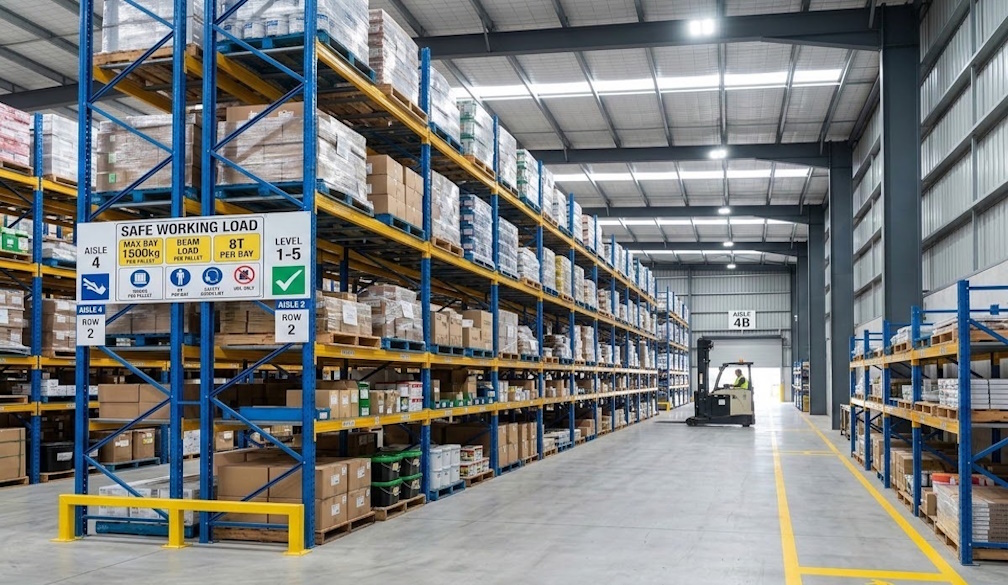
A working warehouse is not a static environment for the racking inside it. Forklift traffic causes impact damage to uprights and frames, often minor enough that it doesn't stop operations but significant enough to reduce load capacity over time. Beams get reconfigured to fit changing stock without anyone rechecking the load rating for the new configuration. Load rating signage fades, gets removed during a repaint, or simply isn't replaced after a relocation. None of these events look dramatic on their own, which is part of why they accumulate rather than get addressed, and why a system that was compliant at installation can drift out of compliance well before anyone notices.
What AS 4084 and WHS Codes Actually Require
Australian Standard AS 4084 governs the design of steel storage racking, and WHS codes of practice extend the obligation beyond design into ongoing use, requiring racking to be inspected periodically by a competent person rather than assumed safe indefinitely after installation. In practice, this generally means a professional inspection on a schedule matched to the warehouse's risk profile, with higher forklift traffic, greater racking height, or denser storage typically warranting more frequent checks than a low-traffic storeroom.
Industry inspections commonly use a three-tier damage rating to communicate findings clearly to warehouse operators: damage classified as low-risk is noted for ongoing monitoring without immediate action, moderate damage is flagged for repair within a defined timeframe, and damage assessed as high-risk calls for the affected bay to be taken out of use immediately until repaired. This tiered approach exists because not every dent or scrape represents the same level of risk, and treating all damage identically, either ignoring it all or shutting down every bay with a mark on it, serves warehouse operations poorly in either direction.
The distinction matters operationally as much as it does for compliance. Shutting down a bay unnecessarily over cosmetic damage disrupts picking and stock flow for no real safety benefit, while leaving genuinely compromised uprights in service because the damage "still looks fine" is how load capacity gets eroded without anyone noticing until it fails under a normal load rather than an unusual one. A documented rating system gives operators a clear, defensible basis for deciding which bays keep operating, which get scheduled for repair, and which need to come out of service today, rather than leaving that call to individual judgement on the warehouse floor.
Where This Fits Into Sourcing and Specification
Businesses researching pallet racking australia wide are often focused on load capacity, configuration and upfront cost, and understandably so, but inspection obligations continue well after installation, since the standard applies to the system's ongoing condition rather than only its original design. A supplier that offers safety audits and ongoing maintenance alongside installation is addressing a genuine, continuing compliance requirement, not offering an optional extra bolted onto the sale.
Not Every Warehouse Needs the Same Inspection Frequency
None of this means every storeroom needs the same inspection regime as a high-throughput distribution centre. A small, low-traffic storage area with minimal forklift movement carries meaningfully less risk than a busy pick face handling constant reconfiguration, and inspection frequency should reflect that difference rather than apply a single blanket schedule everywhere. Staff conducting basic visual checks between formal inspections can catch obvious damage early, which is worth encouraging, but it doesn't substitute for a qualified inspection against the standard, since load capacity calculations and structural assessment require expertise most warehouse staff aren't trained in.
The Actual Question Worth Asking
For a warehouse manager or procurement lead reviewing storage safety, the useful question isn't whether the racking was compliant when it went in. It's when it was last formally assessed against that standard, and what the plan is for the next one. That distinction, between a one-time compliance event and an ongoing obligation, is generally where the real gap in warehouse safety practice sits.
The author writes on warehouse safety and materials handling compliance for Australian industrial and logistics publications.
 Metropolitan Digital