

NATO’s internal cohesion is being threatened (again) – but in pushing for support on Iran, Trump may risk eroding US influence on the alliance
- Written by Michael A. Allen, Professor of Political Science, Boise State University
Soon after the Israeli-U.S. war in Iran began on Feb. 28, 2026, U.S. President Donald Trump called[1] upon NATO allies to help support the effort. The response of European leaders was at first mixed. Some, like the United Kingdom, offering limited or qualified support. Others — chief among them Spain — refused to assist the U.S. at all.
NATO members’ opposition to getting involved with the conflict hardened further after the alliance decided to sit out[2] the subsequent U.S. blockade of the Strait of Hormuz.
The extent of the division between Washington and other members is such that European leaders have quietly begun considering a plan B[3] should Trump make good on his threats[4] to pull out of NATO altogether.
As experts on foreign policy[5], overseas military bases[6] and security cooperation[7], we believe that even though historical tensions within NATO are not new, the recent divisions nonetheless pose a major challenge for the long-term viability of the alliance, particularly in an increasingly fragile U.S.-led international order.
The divisions that preceded Iran
Beyond the recent disagreements over Iran, 2026 has also seen the possibility of conflict between NATO members themselves.
In January, long-standing Trump designs over Greenland[8] seemed closer than ever, with the U.S. verbally, at least, suggesting it was prepared to use economic and military coercion to acquire the territory from Denmark, a NATO ally. Despite tensions having since subsided, Denmark has released unprecedented details about how it prepared[9] to defend against military action by its longtime ally.
While the extent of the Trump-originated rifts are new, NATO member nations disagreeing – sometimes vociferously – is not.
In the 1960s and ‘70s, when the U.S. was embroiled in the Vietnam War, members of Congress called on NATO members[10] to contribute more to their own defense. Those were demands that the first Trump administration would later repeat[11].
In 2003, the U.S. push to invade Iraq also divided NATO[12]. While some members, like the U.K. and Poland, joined the U.S.-led coalition forces in Iraq, others, such as France and Germany, opposed the invasion. Turkey, another NATO member, notably denied the U.S. use of bases[13] in its territory in the lead-up to the campaign.
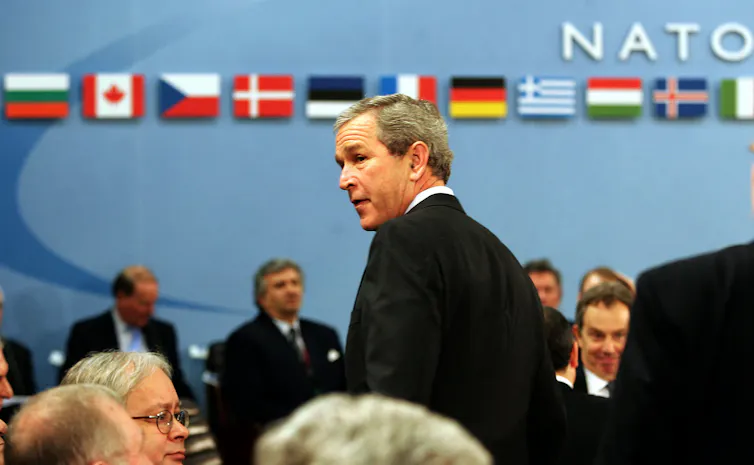
The increasing tensions led the NATO secretary-general at the time, George Robertson of Britain, to downplay[15] the growing divide and assure the world that NATO members still supported the United States.
NATO countries have even come close to war with each other[16] in the past. Most notably, Turkey and Greece came to blows several times, usually over their still-unresolved territorial conflict over Cyprus in the Mediterranean[17].
NATO’s evolving mission
Reducing tensions among European nations was always part of the NATO project. With the two world wars driven in large part by French-German rivalry, reducing intra-alliance conflict was central to NATO’s purpose[18]. The first secretary-general of NATO, Lord Lionel Hastings Ismay, famously described NATO as[19] aimed at “keeping the Russians out, the Americans in and the Germans down.”
With the fall of the Soviet Union, one of NATO’s core pillars collapsed.
In the 1990s, the organization’s mission shifted from an anti-Russian defense pact to promoting European regional security. During this period, NATO took part in conflicts in the Balkans[20] from 1992 to 1999. It still maintains a peacekeeping presence[21] there.
In 2001, when launching its war against Afghanistan, the U.S. invoked Article V, NATO’s collective defense clause, for the first and, to date, only time[22]. This led NATO member nations to become militarily active well beyond Europe’s borders, including operations in Pakistan, the coast of Africa, Libya and Iraq.
The 1990s and early 2000s also saw NATO expand to include several former Soviet republics, a move that Russia opposed as hostile to its interests. In fact, post-Cold War NATO expansion into East Europe has long been one of Russian President Vladimir Putin’s chief grievances[23] against U.S. foreign policy in Europe.
The Russian invasions of Crimea in 2014 and Ukraine in 2022 led to a renewed focus on Russia and Europe’s eastern borders, with NATO member nations coordinating on sanctions and military aid[24] in support of Ukraine’s government. The war also led to another round of expansion, with Finland joining the alliance in 2023 and Sweden in 2024[25].
Trump’s opposition to NATO
While NATO has grown and its mission focus has changed over time, the Trump administration’s call to action against Iran is not an obvious extension of the organization’s evolved focus.
The war is geographically removed from Europe, and Trump has largely been unsuccessful in making the case for why Iran posed an imminent threat to NATO nations. The United States’ motivations and war aims also remain unclear and have been prone to change.
European countries largely agree on issues like preventing Iran from pursuing an unlimited nuclear program. But they have long preferred diplomatic initiatives[26] – like the 2015 nuclear accord deal with Iran brokered during the Obama Administration – to military strikes[27].

Part of the disconnect now is how the U.S. under Trump views multilateral institutions compared with his predecessors. While past U.S. presidents[29] have viewed NATO as an extension of the United States’ global interests, they also tended to value the alliance as a whole, despite Washington[30] not always getting its preferred outcomes from it[31]. For Trump, it is far more transactional.
Indeed, the Trump administration has framed the lack of support from NATO nations as evidence of the alliance’s decreased utility[32] to the U.S.
Secretary of State Marco Rubio recently echoed that position[33], questioning the use of the alliance after several NATO members refused to allow the U.S. to use their airspace to conduct military operations in Iran.
During his first term, Trump also openly questioned NATO’s purpose[34]. And he has repeatedly pressured allies to increase their defense spending[35], suggesting that allies were cheating the U.S. by an overreliance on American military strength.
The specter of unintended consequences
Even before Trump’s threats during his second term, Europe had already decided to change course. After the invasion of Ukraine in 2022 and the increasing fragility of the United States’ involvement in NATO, European countries began increasing military spending[36]; NATO allies have also set targets for further increases in the coming years[37].
Germany aims to increase its military personnel by 50%[38] in the next 10 years, and it has created its first permanent military deployment abroad – in Lithuania[39] – since World War II. France has likewise announced plans to expand its nuclear arsenal[40] and use it for extended deterrence for the rest of Europe.
Ironically, more spending may increase the chance of tensions between the Trump administration and NATO members.
Over time, the U.S. has reaped some benefits when allies spend less on their own defense. That’s because the U.S. has historically provided security guarantees for countries in exchange for more say over their foreign policies – something scholars refer to as the security–autonomy trade-off[41].
However, as the U.S. moves further away from a shared vision with European countries and U.S. policy becomes more volatile, American security guarantees[42] may be less reliable in the eyes of many Europeans. Increased European defense budgets will therefore mean NATO members have more opportunities to assert their preferences against those of the U.S.
A changing role for NATO?
The world for the past 80 years has been characterized largely by U.S. political and military dominance. While it is clear that that world is changing, it is less clear what will replace it.
But understanding NATO’s history and its possible paths forward can give us some clues as to what that world will look like. And contrary to Trump’s short-term aims in nudging NATO allies to rebuild their militaries, a more powerful Europe likely means less U.S. influence in the long term, not more.
References
- ^ U.S. President Donald Trump called (www.washingtonpost.com)
- ^ decided to sit out (www.reuters.com)
- ^ have quietly begun considering a plan B (www.wsj.com)
- ^ make good on his threats (www.washingtonpost.com)
- ^ foreign policy (scholar.google.com)
- ^ overseas military bases (scholar.google.com)
- ^ security cooperation (scholar.google.com)
- ^ Trump designs over Greenland (www.cbsnews.com)
- ^ details about how it prepared (www.theguardian.com)
- ^ members of Congress called on NATO members (www.jstor.org)
- ^ would later repeat (theconversation.com)
- ^ also divided NATO (www.brookings.edu)
- ^ denied the U.S. use of bases (www.theguardian.com)
- ^ Patrick Kovarik/Pool/AFP via Getty Images (www.gettyimages.com)
- ^ NATO secretary-general at the time, George Robertson of Britain, to downplay (www.theguardian.com)
- ^ close to war with each other (www.businessinsider.com)
- ^ their still-unresolved territorial conflict over Cyprus in the Mediterranean (www.businessinsider.com)
- ^ central to NATO’s purpose (www.brookings.edu)
- ^ famously described NATO as (ciaotest.cc.columbia.edu)
- ^ conflicts in the Balkans (www.nato.int)
- ^ maintains a peacekeeping presence (www.nato.int)
- ^ first and, to date, only time (www.lawfaremedia.org)
- ^ chief grievances (www.foreignaffairs.com)
- ^ coordinating on sanctions and military aid (www.nato.int)
- ^ in 2023 and Sweden in 2024 (commonslibrary.parliament.uk)
- ^ they have long preferred diplomatic initiatives (www.cato.org)
- ^ to military strikes (www.aljazeera.com)
- ^ AP Photo/Yorgos Karahalis (newsroom.ap.org)
- ^ past U.S. presidents (www.war.gov)
- ^ Washington (www.cnbc.com)
- ^ its preferred outcomes from it (historycollection.com)
- ^ evidence of the alliance’s decreased utility (www.bbc.com)
- ^ echoed that position (thehill.com)
- ^ openly questioned NATO’s purpose (www.npr.org)
- ^ increase their defense spending (www.bbc.com)
- ^ began increasing military spending (www.stripes.com)
- ^ in the coming years (www.atlanticcouncil.org)
- ^ increase its military personnel by 50% (www.nytimes.com)
- ^ in Lithuania (www.politico.eu)
- ^ expand its nuclear arsenal (www.atlanticcouncil.org)
- ^ security–autonomy trade-off (www.cornellpress.cornell.edu)
- ^ security guarantees (theconversation.com)
Authors: Michael A. Allen, Professor of Political Science, Boise State University