

¡Ándale! ¡Arriba! Speedy Gonzales set to make his triumphant return to the silver screen
- Written by Jared Bahir Browsh, Assistant Teaching Professor of Critical Sports Studies, University of Colorado Boulder
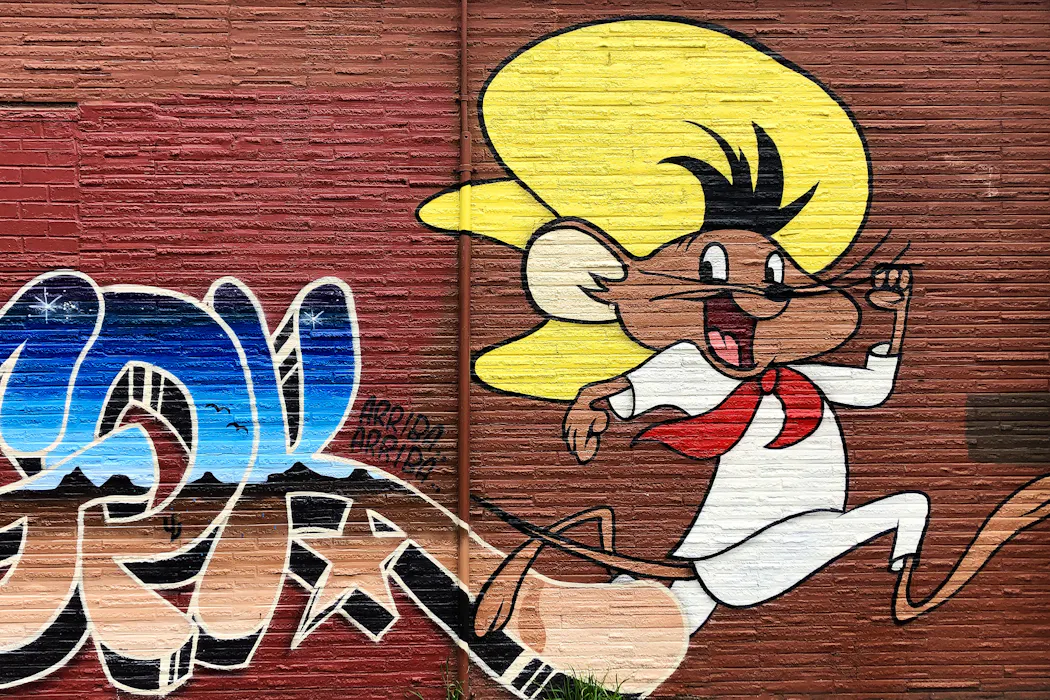
“¡Ándale! ¡Ándale! ¡Arriba! ¡Arriba!”
Meaning “hurry up, let’s go,” the trademark slogan of Speedy Gonzales[1] was, for generations of children, the first Spanish words they learned.
But by the 1980s, ABC had pulled his cartoons[2] due to concerns that his dress, accent and characters like his cousin, Slowpoke Rodriguez, were insensitive toward Mexicans and Mexican Americans. The Cartoon Network followed suit in 1999[3].
I’ve studied and written about the history of animation[4], including how characters have been received around the world. Though rooted in a well-intentioned effort at cultural sensitivity, taking Speedy Gonzales off the air was a step too far for many viewers. He was one of the few cartoon characters rooted in Mexican identity, and he’d become a cultural icon across all of Latin America. The ensuing uproar in the wake of his cancellation prompted the Cartoon Network to reinstate the cartoon mouse in 2002[5].
With Warner Bros. greenlighting a new Speedy Gonzales movie[6] in January 2026, the character’s redemption arc appears complete.
A speedy rise to stardom
“The fastest mouse in all of Mexico” first appeared in the 1953 animated short “Cat-Tails for Two[7].”
He was redesigned with his iconic yellow sombrero and red kerchief when he starred in his eponymous 1955 film[8], which won the Oscar for Best Animated Short[9].
The short film features the general framework for future plots: Speedy helps members of his border community – a place inspired by Ciudad Juarez[10], just south of El Paso, Texas – evade the conniving Sylvester the Cat.
It opens with a town of starving mice looking longingly at the AJAX cheese factory through a fence establishing an “international border.” They try to determine who will try to outrun Sylvester, the factory’s guard. One of the mice says that his sister is friends with Speedy Gonzales. (Another pipes in that Speedy is friends with everybody’s sister, signaling Speedy as something of a Don Juan.) After they call on Speedy, he uses his speed and smarts to outrun and outwit Sylvester.
The basic premise also appears in a number of cartoons, from Tom and Jerry to Roadrunner and Wile E. Coyote: An antagonist is consistently thwarted by a clever protagonist who avoids increasingly complicated traps and attempts at capture.
Speedy Gonzales is unique, though, in that he was the first cartoon star to be from a Latin American country[11].
In the 1940s, with the European and Asian markets cut off due to World War II, Disney had turned to the Latin American market. The studio produced “Saludos Amigos[12]” in 1942 and “The Three Caballeros[13]” in 1944 to abide by President Franklin D. Roosevelt’s Good Neighbor Policy[14], which aimed to leverage diplomacy, trade and cultural exchange to improve relations with Latin America.
Speedy ended up appearing in 45 theatrical shorts. In 1969, Warner Bros. shut down its animation studio, but the character lived on in Saturday morning cartoon anthologies like “The Bugs Bunny Show[15],” which repackaged older cartoons for younger audiences.
Animation’s racial reckoning
The Cartoon Network pulled Speedy Gonzales from the air at a time when networks and studios were starting to reassess animated characters from earlier eras.
Many early cartoon characters, including Mickey Mouse, had been modeled after blackface minstrel characters[16]. Warner Bros.‘ first star, Bosko[17], was originally patented as “Negro Boy.”
Since racist tropes were ubiquitous in early-20th-century animation, films and shorts like Disney’s “Dumbo[18],” “Mickey’s Mellerdrammer[19]” or Warner Bros.’ “All This and Rabbit Stew[20]” were either pulled, edited or updated to feature a content warning.
Speedy Gonzales’ cousin, Slowpoke Rodriguez, was one of the cartoon’s characters deemed culturally insensitive.But after The Cartoon Network pulled Speedy Gonzales from the air in 1999, there was unexpected pushback[21] from the Hispanic American community and the character’s Latin American fans. Groups like League of United Latin American Citizens[22], the oldest Hispanic civil rights organization in the United States, declared Speedy a cultural icon and requested that his cartoons return to the air.
Back when Speedy Gonzales was first introduced to audiences, Hollywood had been filming more movies in Mexico and at the U.S.-Mexico border. However, most of these films depicted Latinos as either incompetent or villains[23].
In this regard, Speedy represented something different[24]. Though the character’s English speech and accent reflected stereotypes – and he was voiced by a white actor, Mel Blanc[25] – the character was ultimately a clever, quick-witted and good-natured protagonist. And the Spanish dubbing of his cartoons in Latin America had removed the stereotypical accent altogether.
Let the people decide
The trajectory of Speedy Gonzales resembles that of another controversial cartoon character: Apu Nahasapeemapetilon from “The Simpsons.”
An Indian immigrant who earned his Ph.D. in computer science in his home country, Apu becomes the manager of a convenience store in the U.S.
Some critics viewed Apu’s depiction as problematic[26]; voiced by a white actor, Hank Azaria, Apu’s exaggerated Indian-American accent and catchphrase – “Thank you, come again” – was routinely mimicked and mocked by viewers of the show. Others, however, saw Apu as the embodiment of the American Dream[27]: He was intelligent, hardworking and morally grounded.
Cultural theorists like Jacques Derrida and Stuart Hall[28] have written about the complexities of how audiences understand – and either resist or embrace – what they read and watch. They ultimately argue that viewers and readers often interpret media however they see fit, regardless of the creators’ intent. For example, many minority groups who are underrepresented or misrepresented in popular culture will nonetheless find their own meaning and inspiration[29] in characters, even if those characters weren’t supposed to represent those groups in the first place.
This happened with “The Goofy Movie.” Some audiences went on to describe the 1995 film as Disney’s first “Black” animated feature[30], despite the fact that the characters’ race is never mentioned. There were hints, of course: Black R&B singer Tevin Campbell[31] played the movie’s fictional pop star, Powerline, and the themes of fatherhood and generational tensions eerily echo those in the play “Fences[32],” written by Black playwright August Wilson.
Of course, in the case of a character like Speedy Gonzales, depictions can become more nuanced as cultural norms and sensitivities change. Jorge R. Gutiérrez[33] is set to direct the animated feature. If his work on films like “The Book of Life[34]” is any indication, he’ll be well-equipped to bring cultural awareness to the animated feature – even if Speedy continues to sport his big, floppy sombrero.
References
- ^ Speedy Gonzales (www.theguardian.com)
- ^ ABC had pulled his cartoons (www.latimes.com)
- ^ followed suit in 1999 (mexiconewsdaily.com)
- ^ history of animation (mcfarlandbooks.com)
- ^ to reinstate the cartoon mouse in 2002 (www.tampabay.com)
- ^ Speedy Gonzales movie (www.syfy.com)
- ^ Cat-Tails for Two (x.com)
- ^ eponymous 1955 film (www.imdb.com)
- ^ the Oscar for Best Animated Short (www.oscars.org)
- ^ inspired by Ciudad Juarez (www.youtube.com)
- ^ cartoon star to be from a Latin American country (www.mysanantonio.com)
- ^ Saludos Amigos (www.imdb.com)
- ^ The Three Caballeros (www.imdb.com)
- ^ Good Neighbor Policy (www.waltdisney.org)
- ^ The Bugs Bunny Show (interviews.televisionacademy.com)
- ^ blackface minstrel characters (www.vox.com)
- ^ Bosko (en.wikipedia.org)
- ^ Dumbo (www.nytimes.com)
- ^ Mickey’s Mellerdrammer (melmagazine.com)
- ^ All This and Rabbit Stew (www.imdb.com)
- ^ there was unexpected pushback (www.latimes.com)
- ^ League of United Latin American Citizens (criticalmediaproject.org)
- ^ incompetent or villains (guides.loc.gov)
- ^ Speedy represented something different (mexiconewsdaily.com)
- ^ Mel Blanc (www.nytimes.com)
- ^ Apu’s depiction as problematic (www.theguardian.com)
- ^ saw Apu as the embodiment of the American Dream (www.theguardian.com)
- ^ Jacques Derrida and Stuart Hall (us2.sagepub.com)
- ^ nonetheless find their own meaning and inspiration (doi.org)
- ^ “Black” animated feature (www.vice.com)
- ^ Tevin Campbell (www.imdb.com)
- ^ Fences (archive.org)
- ^ Jorge R. Gutiérrez (www.hollywoodreporter.com)
- ^ The Book of Life (www.imdb.com)
Authors: Jared Bahir Browsh, Assistant Teaching Professor of Critical Sports Studies, University of Colorado Boulder