

How polling failures, gambling legalization and political gridlock paved the way for the explosive rise of prediction markets
- Written by Parker Bach, PhD Student in Media and Communication, University of North Carolina at Chapel Hill
Though prediction markets have been legal in the U.S. for less than 18 months, they can’t stop making news and making money[1].
On prediction markets such as Kalshi and Polymarket, users can stake real money on just about anything, from the winner of the 2028 U.S. presidential election[2] to when Taylor Swift will get married[3].
But this isn’t simple entertainment: In theory, these wagers serve as a means of collecting the public’s insights into the future.
That’s why you may have seen CNN’s pundits[4] casually mention Kalshi’s election odds for the 2026 primaries, or watched CBS offer real-time Polymarket projections of which actors would win awards during the Golden Globes[5].
Existing research on the principles and history of prediction markets suggests they can be a valuable way of pooling collective knowledge about the future.
But as researchers like me[6], journalists[7] and legislators[8] race to understand the impact these markets are having on society and politics, several questions have emerged about the regulation of these platforms and their forecasting abilities.
The what and why of prediction markets
In practice, prediction markets are quite simple.
Each market offers what are known as “event contracts” on whether some future outcome will occur. Each contract costs between 1 and 99 cents, paying out US$1 if the event occurs or nothing if it does not.
Similar to sports betting, purchasing a contract represents a wager. There are higher returns for positions on outcomes deemed less likely. Like in the stock market, a trader can buy and sell contracts over time, as odds – and thus prices – fluctuate.
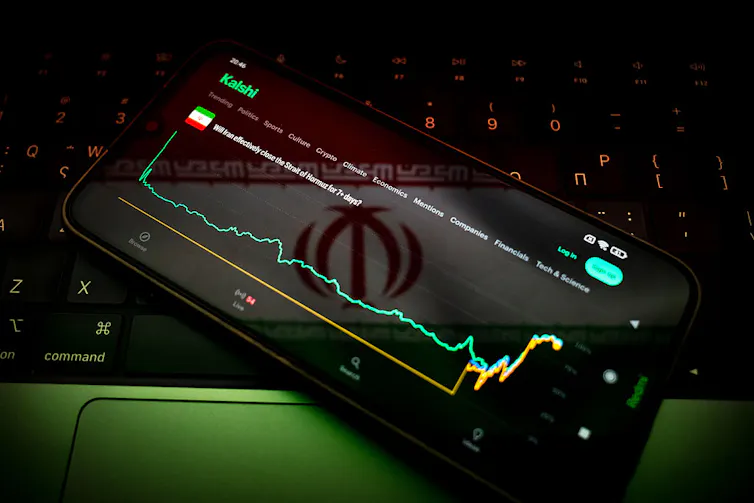
At the time of writing, Kalshi traders put the odds of the passage of the SAVE Act[9], legislation centered on requiring proof of U.S. citizenship to register to vote, at about 10%[10]. So each contract for this outcome costs 10 cents. If I think the act is more likely to pass than that, I could purchase some “shares” and sell them at a higher price if the odds go up in the future. If I hold them and the bill ultimately becomes law, I would receive a return that’s 10 times what I originally paid.
Two theories support the idea that prediction markets should excel at forecasting: the wisdom of crowds and the efficient market hypothesis.
First described over a century ago[12], the wisdom of crowds[13] refers to the idea that the median judgment of a large, diverse group of people operating independently is often more accurate than that of a single expert.
A related argument appears in the efficient market hypothesis, which emerged in the mid-20th century among economists who championed free markets[14]. It holds that prices encode all available information, reflecting the collective judgments of profit-seeking sellers and deal-seeking buyers.
At their best, then, prediction markets aggregate collective intelligence to weigh the likelihood of future events.
Polling’s credibility crisis creates an opening
Gambling on the outcomes of the day’s events has a long history. In 16th-century Italy[15], gamblers could wager on the election of civic magistrates and the outcome of papal conclaves. And from the 1880s to 1930s[16], New York City was the hub of political wagering, which sometimes exceeded the stock market in daily volume.
Reporting on bets ahead of the 1924 presidential election, The New York Times observed[17], “It is an old axiom in the financial district that Wall Street betting odds are ‘never wrong.’”
However, the rise of scientific polling[18] and legal crackdowns on political wagering[19] forced prediction markets to fade to the background.
That changed in 2024.
One month before the U.S. elections, a federal court granted the prediction market startup Kalshi permission to legally operate prediction markets[20] concerning U.S. election results.
Around the same time, Elon Musk posted[21] on X about Donald Trump leading Kamala Harris in prediction market odds. Trump followed suit[22]. Kalshi put up billboards with live election odds in Times Square. Users and dollars flowed in. By election day, a volume of over $500 million in presidential election bets[23] had been traded on Kalshi alone. Polymarket[24] featured over $3.6 billion more in volume.
Political polling, meanwhile, was facing a crisis of confidence. Response rates had been declining[25] for decades, and Trump voters had been undercounted in 2016 and 2020.
The polls forecast[26] the presidential election as a coin toss. The prediction market, meanwhile, favored Trump at roughly 60% odds to win.
After Trump won at the ballot box, prediction markets declared victory over polling[27] as the new, trustworthy forecasters of public opinion.
The utility of the markets
Over the past 50 years, journalists have increasingly[28] incorporated quantitative data in their reporting, and audiences have come to expect political forecasting[29] as part of their news diet.
With polling experiencing a crisis of confidence[30], prediction markets have become an increasingly attractive way for journalists to offer a data-backed snapshot of public beliefs.
Prediction markets have other advantages over polls for journalists. They respond to events in real time, and they’re free to access. Polls, meanwhile, take time and money to administer. They provide forecasts for political outcomes that go beyond elections – such as Cabinet nominations[31] and Supreme Court decisions[32] – which are usually outside the purview of polling.
In recent months, Kalshi and Polymarket have inked several[33] partnership[34] deals[35] with news outlets. There’s a symbiotic relationship at play: Prediction markets provide journalists with data to report and discuss. Journalists, in turn, legitimize prediction markets[36] by citing them as a trusted source.

Prediction markets have historically performed well on elections[38]. Whether they’re more accurate than polls on other kinds of questions is still up for debate.
If traders behave purely rationally, in the economic sense, they might flit between positions to maximize profit based on new information, personal biases aside.
But when wagering on elections, most traders have seemed to consistently buy and sell only one position[39], rather than switching between them. They may think they’re trading rationally while exhibiting a “wishful thinking” bias[40]. Or, like many sports bettors[41], they may be wagering out of fandom or for entertainment.
All of these scenarios could undercut the accuracy of these markets.
The elephant in the room
Many journalists are embracing the data even as their news outlets run stories about concerns over insider trading in predictive markets. Because the outcome of events is often determined by human actors, those privy to certain plans – say, a looming ceasefire deal – would have access to information not available to the public and could profit handsomely off that information.
Two anonymous accounts made hundreds of thousands of dollars predicting the downfall of Nicolás Maduro[42] and betting on the toppling of Ayatollah Ali Khamanei[43], with traders putting their money down just before the U.S. took military action. This timing has raised some eyebrows.
Kalshi prohibits insider trading[44], and in early 2026 it fined and suspended[45] two high-profile traders who were using inside information.
Likely in response to bad press and statements from lawmakers seeking to regulate the platforms[46], Kalshi and Polymarket also announced new insider trading rules[47] on March 23, 2026, centered on politics and sports.
The legal mechanisms for enforcing these rules, however, are less clear. SEC Rule 10b5-1[48] prohibits trading securities on the basis of material nonpublic information.
But event contracts are not governed by the SEC. They’re under the purview of the Commodity Futures Trading Commission[49], a much smaller agency. As things stand, the small agency has too few employees to regulate the legality of specific event contracts, which are governed by the Commodity Exchange Act[50]. Kalshi and certain other prediction market platforms are instead given the latitude to self-certify the legality of each contract.
Any efforts to meaningfully regulate insider trading would, in my view, require clear rules and viable enforcement mechanisms.
From participation to profit
As I conduct my research, I often consider what the booming popularity of prediction markets says about American culture and politics in 2026.
In 1969, sociologist Erving Goffman theorized[51] that Americans’ attraction to gambling stemmed from a need for “action” in an increasingly bureaucratized society. Similarly, studies have suggested that betting on sports[52] makes fans feel like they’re participating, not just observing.
Congress is less productive than ever[53]. Most Americans feel they have little influence[54] over the workings of the government, with many looking on helplessly as democratic guardrails have been dismantled[55].
Who knows what will happen in the coming year. The filibuster might be weakened[56], or the U.S. could invade Cuba[57]. Most Americans will have little say. But prediction markets at least offer the chance to make a buck off the action.
References
- ^ can’t stop making news and making money (www.wsj.com)
- ^ winner of the 2028 U.S. presidential election (kalshi.com)
- ^ when Taylor Swift will get married (polymarket.com)
- ^ CNN’s pundits (news.kalshi.com)
- ^ Golden Globes (www.hollywoodreporter.com)
- ^ But as researchers like me (scholar.google.com)
- ^ journalists (www.nytimes.com)
- ^ and legislators (www.aljazeera.com)
- ^ the SAVE Act (www.congress.gov)
- ^ at about 10% (kalshi.com)
- ^ Nikolas Kokovlis/NurPhoto via Getty Images (www.gettyimages.com)
- ^ over a century ago (www.nature.com)
- ^ wisdom of crowds (books.google.com)
- ^ among economists who championed free markets (www.jstor.org)
- ^ 16th-century Italy (www.bloomsbury.com)
- ^ from the 1880s to 1930s (www.aeaweb.org)
- ^ The New York Times observed (www.nytimes.com)
- ^ rise of scientific polling (www.hup.harvard.edu)
- ^ legal crackdowns on political wagering (www.cftc.gov)
- ^ permission to legally operate prediction markets (law.justia.com)
- ^ Elon Musk posted (x.com)
- ^ Trump followed suit (truthsocial.com)
- ^ over $500 million in presidential election bets (kalshi.com)
- ^ Polymarket (polymarket.com)
- ^ had been declining (www.pewresearch.org)
- ^ polls forecast (abcnews.com)
- ^ declared victory over polling (kalshi.com)
- ^ journalists have increasingly (academic.oup.com)
- ^ expect political forecasting (doi.org)
- ^ crisis of confidence (doi.org)
- ^ Cabinet nominations (kalshi.com)
- ^ Supreme Court decisions (polymarket.com)
- ^ several (news.kalshi.com)
- ^ partnership (www.dowjones.com)
- ^ deals (www.cnbc.com)
- ^ legitimize prediction markets (doi.org)
- ^ Théo Marie-Courtois/AFP via Getty Images (www.gettyimages.com)
- ^ performed well on elections (academic.oup.com)
- ^ buy and sell only one position (papers.ssrn.com)
- ^ wishful thinking” bias (papers.ssrn.com)
- ^ like many sports bettors (doi.org)
- ^ downfall of Nicolás Maduro (www.pbs.org)
- ^ toppling of Ayatollah Ali Khamanei (www.npr.org)
- ^ prohibits insider trading (kalshi.com)
- ^ fined and suspended (news.kalshi.com)
- ^ lawmakers seeking to regulate the platforms (www.aljazeera.com)
- ^ new insider trading rules (apnews.com)
- ^ SEC Rule 10b5-1 (www.law.cornell.edu)
- ^ Commodity Futures Trading Commission (www.cftc.gov)
- ^ Commodity Exchange Act (www.cftc.gov)
- ^ Erving Goffman theorized (archive.org)
- ^ suggested that betting on sports (www.taylorfrancis.com)
- ^ Congress is less productive than ever (www.reuters.com)
- ^ feel they have little influence (www.pewresearch.org)
- ^ democratic guardrails have been dismantled (www.v-dem.net)
- ^ The filibuster might be weakened (kalshi.com)
- ^ U.S. could invade Cuba (polymarket.com)
Authors: Parker Bach, PhD Student in Media and Communication, University of North Carolina at Chapel Hill