

Research at Chernobyl and Fukushima shows how radioactive materials move in the environment
- Written by Eduardo B. Farfán, Professor of Nuclear Engineering, Director of the Center for Nuclear Studies, Kennesaw State University
When nuclear accidents happen, many people imagine radiation spreading everywhere and lasting forever. The reality is more complex. Radioactive materials move, change and sometimes disappear faster than people expect.
The Chernobyl accident in 1986[1] and the Fukushima Daiichi accident in 2011[2] released radioactive materials into the air, soil and water around those two nuclear power plants. The general term for the materials that got released is “radionuclides[3].”
Some decayed quickly, effectively disappearing without having done much harm. But others, mostly isotopes of iodine[4], cesium[5], strontium[6] and plutonium[7], remained in the environment for many years, damaging human health and the environment. The mechanisms by which they do that damage depends on the material itself, the weather and the local environment. For example, cesium chemically behaves like sodium and potassium[8], which are accumulated in human tissues. Strontium chemically behaves like calcium[9], which is accumulated in bones.
As a nuclear engineer and researcher[10] who has worked on tracking radiation levels and exposure in projects related to Chernobyl, Fukushima Daiichi, and U.S. Department of Energy national laboratories and nuclear sites, I have seen how science and engineering help measure, map and manage radiation to keep people safe. I study how radionuclides migrate[11] because this helps predict where radioactive contamination goes, how fast it moves, and who or what might be exposed over time.
The most important lesson is that radiation risk can be understood and controlled. Human senses can’t detect radiation, but scientific instruments[12] can accurately measure the amounts and types of radiation[13] in an area. Once it is measured, scientists and engineers can make informed decisions about how to use well-established methods and modern technology[14] to reduce risk[15].
How radioactivity travels
The major nuclear accidents at Chernobyl[17] and Fukushima Daiichi[18] released radioactive materials into the atmosphere as tiny particles. Winds carried these particles[19] across countries and even between continents. Rain and snow brought them out of the air and down to the ground.
Soil plays a very important role in what happens next. Some radionuclides stick strongly to soil and do not move very much. Others move more easily[20] and travel slowly downward through the soil toward groundwater or get washed into rivers, lakes and oceans.
Radioactivity also moves through water. After the Fukushima Daiichi nuclear disaster, radionuclides entered the ocean through direct releases and runoff. Scientists monitored seawater, fish and seaweed[21] to track how radioactive materials moved and changed over time. Monitoring showed that radionuclides such as cesium spread through coastal waters but became diluted and dispersed over time[22], with levels in most areas farther out in the ocean decreasing and remaining low and relatively stable[23] after the initial release. Continuous sampling of water and marine life also showed that radioactivity in seafood generally declined[24] over time and distance from Fukushima, remaining within safe limits.
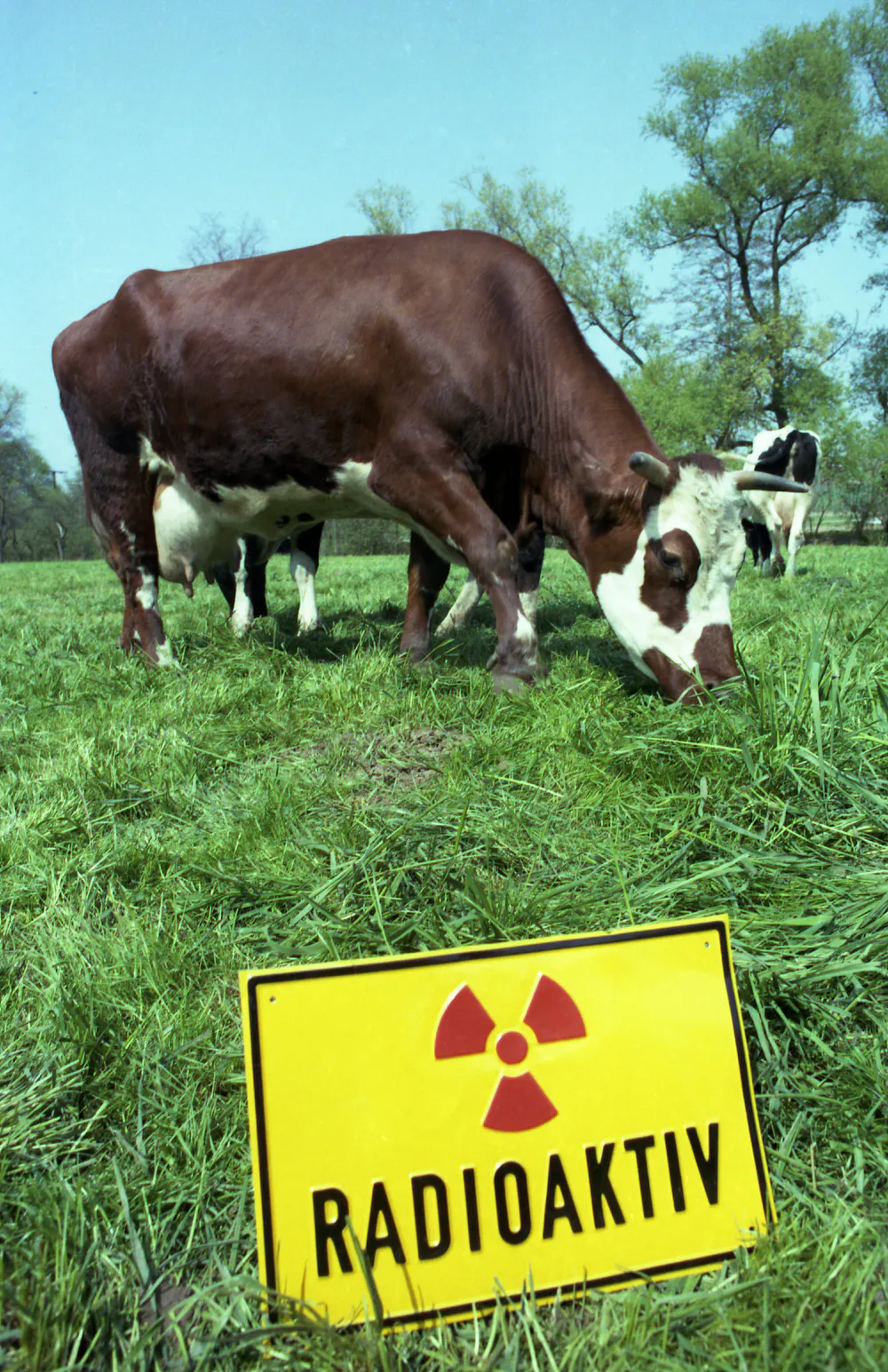
From soil and water, radioactive materials also moved into plants and animals, which posed risks to human health[25]. For instance, grass absorbed radionuclides from soil, cows ate the grass, and radionuclides then appeared in the cows’ milk[26]. The International Atomic Energy Agency, World Health Organization, and Food and Agriculture Organization all have programs that look for radioactivity in foods[27] to keep unsafe food off the market.

Measuring and mapping radiation
Though radiation cannot be detected by human senses, there are many proven ways to measure and monitor it in the environment. Scientists use handheld detectors such as Geiger counters, laboratory instruments and fixed environmental monitoring stations. These tools measure radiation in soil, water, air and food, helping assess exposure and guide safety decisions.
Modern technologies go further by combining detector data with imaging and mapping systems. These systems can create three-dimensional maps that show where radiation is located and how it spreads[29]. Such maps have been used, for example, after the Fukushima Daiichi nuclear disaster to visualize contamination patterns and guide cleanup.
Researchers don’t monitor radiation only after accidents. Many countries, such as the U.S. and European countries, also constantly monitor radiation[30] as part of their environmental protection programs. These monitoring systems measure natural background radiation and look for unusual increases. This helps detect problems early and ensures that radiation levels remain safe for the public.
A 3D digital model from the Japan Atomic Energy Agency shows where radiation was highest and lowest at the Fukushima Daiichi reactor site.Cleaning up radiation
When and where radiation is detected, managing it can take several forms[31], depending on the type of contamination and how much there is.
One common method is removing contaminated soil[32] and transporting it in sealed, labeled containers to licensed storage or disposal facilities, where it is stored in special buildings that isolate the material from the environment and prevent leaks into soil or groundwater.
Another method involves covering contaminated areas with clean soil[33], clay or concrete. This approach does not remove the radioactivity but rather acts as a barrier that reduces radiation exposure and helps prevent contaminated particles from being spread by wind, water or human activity.
In some cases, chemicals are added to the soil to reduce the mobility of radionuclides and limit their uptake by plants. After the Chernobyl disaster, for example, national governments and international agencies applied potassium fertilizers[34] to soils to reduce the uptake of radioactive cesium by crops. Following the Fukushima Daiichi nuclear disaster, large areas of farmland were treated similarly[35], and contaminated topsoil was removed[36] and stored in temporary as well as long-term facilities.
Scientists also use computer models to predict how radiation moves[37] in air, soil and water. These models help estimate radiation risks and help decision-makers choose the best cleanup strategy. The goal is to reduce radiation exposure as much as reasonably achievable.
 People working on the cleanup of the Fukushima Daiichi disaster wear protective clothing to reduce their risk of exposure and contamination.
AP Photo/Issei Kato[38]
People working on the cleanup of the Fukushima Daiichi disaster wear protective clothing to reduce their risk of exposure and contamination.
AP Photo/Issei Kato[38]
Lessons learned over time
Long-term studies in the Chernobyl exclusion zone[39] have helped scientists understand how radionuclides behave over decades. Researchers have examined how radionuclides such as cesium and strontium isotopes migrate[40] through forests, lakes[41], soils[42] and built-up areas[43], providing critical data for predicting long-term environmental and health effects.
These studies have shown that radionuclide movement is influenced by environmental factors, such as soil composition, moisture and biological activity, and that contamination can remain mobile and biologically relevant for decades.
Some of this work includes my own research and collaborations. For example, I have contributed to studies evaluating radionuclide migration in soils and ecosystems[44] within and around the 18-mile (30-kilometer) exclusion zone, including how these materials move vertically through soil layers and accumulate in vegetation and wildlife. My work has also examined how radionuclides penetrate and persist in concrete structures in contaminated areas such as Pripyat[45], as well as how radiation doses affect small animals and ecological systems over time.
Overall, this body of research has improved understanding of how radiation moves and how best to monitor it, informing emergency response and long-term remediation strategies[46] around the world.
Research has also found that straightforward communication is also very important after a nuclear accident. The public needs clear, honest and simple explanations[47] about what is happening and what is being done[48] to protect them.
In practice, however, this level of communication is often difficult to achieve during a crisis[49]. In the aftermath of both disasters, investigations later showed that information provided to the public was sometimes delayed, incomplete or inconsistent[50]. These communication gaps contributed to confusion, mistrust and increased anxiety among affected populations[51].
As a result, one of the key lessons learned from these events is the importance of timely, transparent and accurate communication[52]. Emergency response plans[53] today emphasize clear messaging, regular updates and the use of multiple communication channels[54] to ensure that the public understands both the risks and the protective actions being taken.
References
- ^ Chernobyl accident in 1986 (world-nuclear.org)
- ^ Fukushima Daiichi accident in 2011 (world-nuclear.org)
- ^ radionuclides (www.epa.gov)
- ^ mostly isotopes of iodine (www.epa.gov)
- ^ cesium (www.epa.gov)
- ^ strontium (www.who.int)
- ^ plutonium (www.nrc.gov)
- ^ cesium chemically behaves like sodium and potassium (www.ncbi.nlm.nih.gov)
- ^ Strontium chemically behaves like calcium (doi.org)
- ^ nuclear engineer and researcher (scholar.google.com)
- ^ how radionuclides migrate (doi.org)
- ^ scientific instruments (www.nrc.gov)
- ^ measure the amounts and types of radiation (www.nrc.gov)
- ^ well-established methods and modern technology (www.bfs.de)
- ^ reduce risk (www.osha.gov)
- ^ AP Photo/Frank Rumpenhorst (newsroom.ap.org)
- ^ Chernobyl (www.iaea.org)
- ^ Fukushima Daiichi (www.unscear.org)
- ^ Winds carried these particles (www.iaea.org)
- ^ Others move more easily (nepis.epa.gov)
- ^ monitored seawater, fish and seaweed (www.whoi.edu)
- ^ diluted and dispersed over time (www.pacioos.hawaii.edu)
- ^ remaining low and relatively stable (doi.org)
- ^ radioactivity in seafood generally declined (www.fisheries.noaa.gov)
- ^ posed risks to human health (pubmed.ncbi.nlm.nih.gov)
- ^ radionuclides then appeared in the cows’ milk (doi.org)
- ^ radioactivity in foods (www.who.int)
- ^ AP Photo (newsroom.ap.org)
- ^ where radiation is located and how it spreads (www.jaea.go.jp)
- ^ constantly monitor radiation (www.epa.gov)
- ^ managing it can take several forms (www.iaea.org)
- ^ removing contaminated soil (www.epa.gov)
- ^ covering contaminated areas with clean soil (www.epa.gov)
- ^ applied potassium fertilizers (www.oecd-nea.org)
- ^ large areas of farmland were treated similarly (doi.org)
- ^ contaminated topsoil was removed (world-nuclear.org)
- ^ computer models to predict how radiation moves (www.ukhsa-protectionservices.org.uk)
- ^ AP Photo/Issei Kato (newsroom.ap.org)
- ^ Long-term studies in the Chernobyl exclusion zone (doi.org)
- ^ cesium and strontium isotopes migrate (doi.org)
- ^ lakes (doi.org)
- ^ soils (www.osti.gov)
- ^ built-up areas (www.oecd-nea.org)
- ^ radionuclide migration in soils and ecosystems (doi.org)
- ^ concrete structures in contaminated areas such as Pripyat (doi.org)
- ^ emergency response and long-term remediation strategies (www.iaea.org)
- ^ clear, honest and simple explanations (www.iaea.org)
- ^ what is being done (doi.org)
- ^ difficult to achieve during a crisis (www.iaea.org)
- ^ delayed, incomplete or inconsistent (www.iaea.org)
- ^ increased anxiety among affected populations (www.who.int)
- ^ timely, transparent and accurate communication (www.cdc.gov)
- ^ Emergency response plans (www.nrc.gov)
- ^ multiple communication channels (www.who.int)
Authors: Eduardo B. Farfán, Professor of Nuclear Engineering, Director of the Center for Nuclear Studies, Kennesaw State University