

The good life requires two things, self-knowledge and friends – you can’t have one without the other
- Written by Ross Channing Reed, Lecturer in Philosophy, Missouri University of Science and Technology
Friends can help us with all kinds of things in life. How could I forget moving that piano for friends in Chicago? Fortunately, none of us ended up in the ER.
One of the most important things friends do, though, might seem surprising: They help us get to know ourselves.
Both in their 50s, Cindy and Ann had been friends since the second grade. Year after year, they never missed a birthday. Cindy would give Ann gourmet popcorn or maybe a sweatshirt from her alma mater, while Ann would give Cindy a special book on a topic that interested her, or maybe an old batch of family recipes. At one point, it dawned on Cindy just how thoughtful Ann’s gifts were. It wasn’t about the cost. “She really thinks about my life and what I’m doing,” Cindy said. “It’s amazing. Ann is just really thoughtful.”
Cindy had always imagined herself as a thoughtful person, too. But in comparing the kinds of gifts they sent to each other, she realized that she was not thinking about Ann in the way that Ann was thinking about her. And so began her deliberate process of becoming more thoughtful – as a result of the self-insight she had gained from her friendship with Ann.
As a philosopher[1] and philosophical counselor[2], I’ve noticed the pronounced connection between friendship and self-knowledge in my counseling practice. Cindy and Ann are one example among many. I’ve come to the conclusion that to really know yourself, it’s necessary to have good friends.
The link between self-knowledge and friendship was key for Aristotle, too, more than 2,000 years ago. “Eudaimonia” – roughly translated as living well, or happiness – often remains elusive, yet Aristotle believed it didn’t have to be. Eudaimonia is largely within people’s control[3], he said, so long as they aim at the right targets[4].
Two of those targets[5] are knowing yourself and having good friends[6]. The two are tied together – you can’t develop self-knowledge in a vacuum. Happiness, for Aristotle, can never be a solitary pursuit[7].
Knowing – and befriending – yourself
Humans have a highly developed capacity to think about their thinking[8]. This is possible because of a split in human consciousness: There is consciousness, and there is consciousness of consciousness – what is known as reflection or metacognition[9]. Metacognition allows us to step back and note our thoughts and feelings, analyzing them almost as if they belonged to someone else.
This split makes reason[10], self-knowledge and morality possible[11]. We can deliberate about our thoughts, feelings and potential actions.
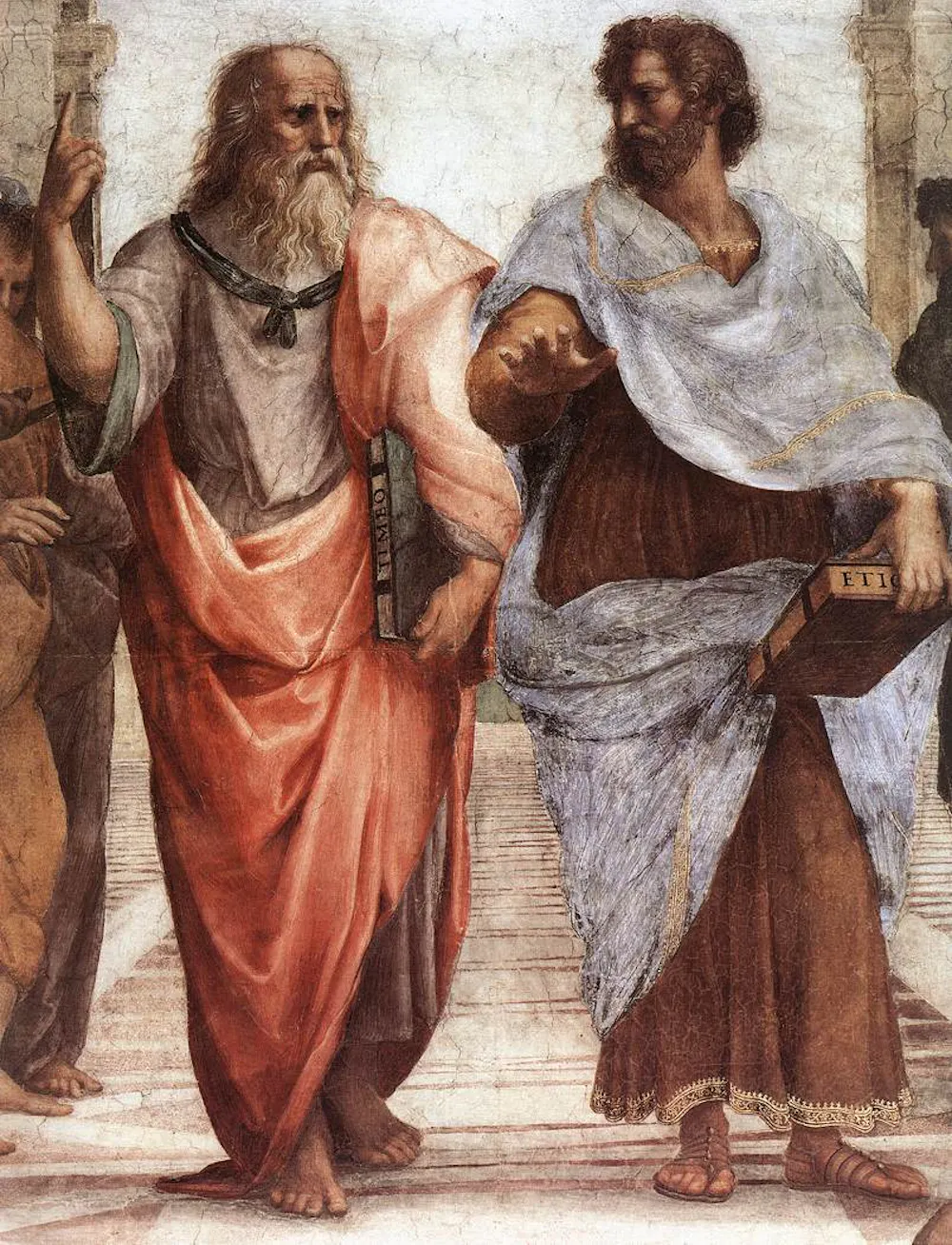
Self-knowledge[13] isn’t the same as being intellectual or even intelligent. Instead, it’s about using self-awareness and reason to develop character[14].
In Aristotle’s view, character arises[15] from developing habits[16] that lead to intellectual and moral virtue, so that personal integrity is possible. This, in turn, builds self-trust and self-respect[17], as you learn to rely on yourself to do what is right – what Aristotle called “enkratēs,” or continence.
In other words, self-knowledge is developing a good relationship with yourself. In your own internal dialogue, you become another trusted friend to yourself, based on what you’ve seen in your friendships: virtues like generosity, courage, truthfulness and prudence. Self-knowledge and moral development are tied together and realized in community, as underscored by Aristotle scholar[18] Joseph Owens[19].
Friendship based on character
Aristotle recognized three types of friendship[20]. Some are based on utility, like a study-group friend. Others are based on pleasure, such as friends in an antique car club.
The third and highest form of friendship, which can last a lifetime, is based on virtue[21], or “arete.”
In these situations, Aristotle wrote, a friend becomes “another self[22].” These friendships are based on mutual goodwill and love for the other person’s character[23]; they are not fundamentally transactional. Instead, they are anchored in care and concern for the other.
Such friendships are few[24], but foster self-knowledge. As philosopher Mavis Biss[25] emphasizes, a good friend has a perspective on you[26] that you yourself do not. You can step back and analyze your desires, thoughts and feelings, but you can never actually observe yourself.
That means self-knowledge always has a social dimension[27]. True friends enhance each other’s insight[28] and capacity for virtue. As you get to know your friend, you get to know yourself – and are challenged to become a better version of yourself.
“To perceive and to know a friend, therefore, is necessarily in a manner to perceive and in a manner to know oneself[29],” Aristotle wrote in the “Eudemian Ethics[30].” The friend is a mirror that helps refine[31] our thinking, perception and moral understanding.

Aiming at the good life
In the end, what makes eudaimonia – the good life – possible? For Aristotle, it’s using reason to become our best selves. Knowledge and self-knowledge[33] are the most desirable of all things[34], Aristotle argued: “One always desires to live because one always desires to know, and because one wishes to be oneself the object known[35].”
And there’s no way to get there without good friends[36]. A trusted and respected friend[37] shares perceptions, enhances self-knowledge and magnifies life’s pleasures.
The desire to know and be known is part of the quest for happiness. Knowledge of self, others and everything else is interconnected. For Aristotle, relationships are a portal into the realms of the vast and mysterious universe.
References
- ^ a philosopher (thephilosophicalsalon.com)
- ^ philosophical counselor (www.psychologytoday.com)
- ^ within people’s control (www.perseus.tufts.edu)
- ^ right targets (www.perseus.tufts.edu)
- ^ targets (www.perseus.tufts.edu)
- ^ having good friends (www.perseus.tufts.edu)
- ^ solitary pursuit (www.perseus.tufts.edu)
- ^ capacity to think about their thinking (doi.org)
- ^ or metacognition (doi.org)
- ^ makes reason (www.perseus.tufts.edu)
- ^ and morality possible (www.perseus.tufts.edu)
- ^ Apostolic Palace/Web Gallery of Art via Wikimedia Commons (commons.wikimedia.org)
- ^ Self-knowledge (doi.org)
- ^ develop character (www.perseus.tufts.edu)
- ^ character arises (www.perseus.tufts.edu)
- ^ developing habits (www.perseus.tufts.edu)
- ^ self-respect (www.perseus.tufts.edu)
- ^ Aristotle scholar (philpeople.org)
- ^ Joseph Owens (www.jstor.org)
- ^ types of friendship (www.perseus.tufts.edu)
- ^ based on virtue (www.perseus.tufts.edu)
- ^ another self (www.perseus.tufts.edu)
- ^ love for the other person’s character (classics.mit.edu)
- ^ are few (www.perseus.tufts.edu)
- ^ philosopher Mavis Biss (www.loyola.edu)
- ^ has a perspective on you (www.jstor.org)
- ^ social dimension (philpapers.org)
- ^ enhance each other’s insight (www.jstor.org)
- ^ know oneself (www.loebclassics.com)
- ^ Eudemian Ethics (ia800704.us.archive.org)
- ^ helps refine (www.perseus.tufts.edu)
- ^ Johner Images/Johner Images Royalty-Free via Getty Images (www.gettyimages.com)
- ^ Knowledge and self-knowledge (classics.mit.edu)
- ^ of all things (www.perseus.tufts.edu)
- ^ object known (www.perseus.tufts.edu)
- ^ good friends (www.perseus.tufts.edu)
- ^ A trusted and respected friend (www.jstor.org)
Authors: Ross Channing Reed, Lecturer in Philosophy, Missouri University of Science and Technology