

Targeting of energy facilities turned Iran war into worst-case scenario for Gulf states
- Written by Kristian Coates Ulrichsen, Fellow for the Middle East at the Baker Institute, Rice University
The U.S.-Israeli military campaign against Iran took a dangerous turn on March 18, 2026, with tit-for-tat strikes[1] on critical energy infrastructure that amount to the most serious regional escalation since the conflict began.
First, an Israeli drone strike targeted facilities[2] at Iran’s Asaluyeh complex, damaging four plants that treat gas from the offshore South Pars field, which straddles the maritime boundary between Iran and Qatar.
Tehran vowed to retaliate[3] by hitting five key energy targets in Saudi Arabia, Qatar and the United Arab Emirates. Hours later, Iranian missiles caused[4] “extensive damage” to Ras Laffan, the heart of Qatar’s energy sector. Qatar’s state-owned petroleum company said additional attacks on March 19[5] had targeted liquefied natural gas facilities.
Separate suspected Iranian aerial attacks also caused damage[6] to oil refineries in Kuwait and Saudi Arabia and led to the closure of gas facilities in the United Arab Emirates.
Much attention has been focused on the seemingly unanticipated consequences of the U.S.-Israeli strikes on Iran and the de facto closure of the Strait of Hormuz to international shipping. But as a scholar of the Gulf[7], I believe that the targeting of energy facilities is close to a worst-case outcome for regional states. Export revenues from oil and, in Qatar’s case, natural gas have transformed the Gulf states into regional powers with global reach over the past three decades, and that is now at risk.
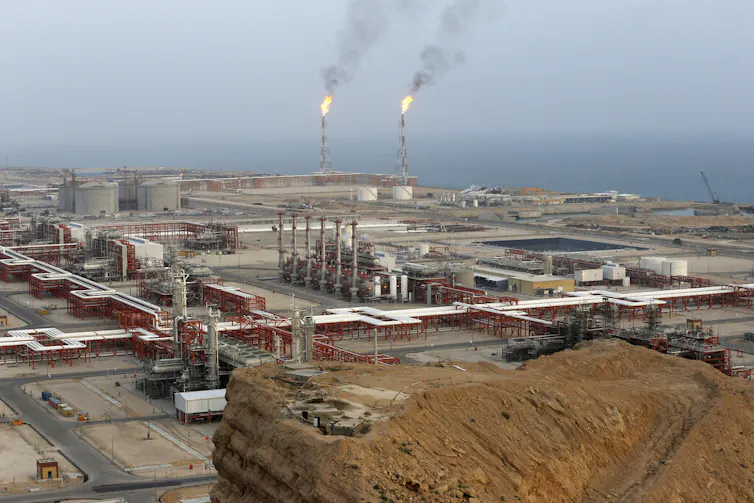
Energy becomes a battlefield
The offshore gas field that lies on both sides of the maritime boundary between Qatar and Iran is the world’s largest reserve of so-called nonassociated gas. This means that the gas is not connected[9] to the production of crude oil and is unaffected by decisions to raise or lower output according to, for example, OPEC quotas.
The field, known as the North Field on the Qatari side and South Pars on the Iranian side, was discovered in 1971[10]. Development of its massive resources began in earnest in the 1980s. Largely because of the field, Iran and Qatar have the second- and third-largest proven gas reserves in the world, respectively.
While Israel attacked gas facilities in southern Iran on the second day of the 12-day war in June 2025, oil and gas infrastructure was largely spared during that earlier conflict. The opening two weeks of the current fighting, however, have seen a significant loosening of the restraints on targeting critical infrastructure.
On March 8, Israel struck oil storage facilities[11] in Tehran, starting large fires and blanketing the capital in plumes of smoke and toxic, so-called black rain. For their part, Iranian officials signaled that energy facilities were on the table as swarms of its drones targeted the Shaybah[12] oil field in Saudi Arabia, the Shah gas field[13] southwest of Abu Dhabi and oil facilities[14] in Fujairah.
One of the seven emirates of the United Arab Emirates along with Abu Dhabi, Fujairah is strategically located on the Gulf of Oman, outside the Strait of Hormuz, with direct access to the Indian Ocean. For this reason, it has grown into an important[15] oil-loading and ship fuel-supplying hub and is the terminus for the Abu Dhabi crude oil pipeline.
Opened in 2012, that pipeline has a capacity of 1.5 million barrels per day, covering more than half of the UAE’s oil exports. Its repeated targeting[16] during the war signifies Iranian intent to disrupt one of the two pipelines that bypass Hormuz. Thus far, the other pipeline, the East-West pipeline[17] from the eastern Saudi oil fields to the Red Sea port of Yanbu, has not been targeted.
But that could quickly change, as early on March 19 Saudi authorities reported that a drone had struck[18] a refinery at Yanbu, while a ballistic missile that targeted[19] the port had been intercepted.
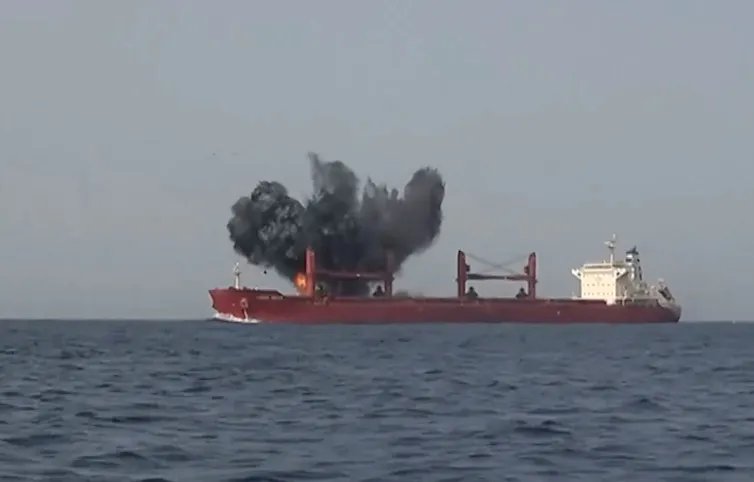
Cascading risks of further energy attacks
On at least four occasions over the past decade, most recently in 2022, Houthi forces in Yemen – who are allied with Iran– struck targets around the East-West pipeline.
And in 2024 and 2025, in defiance of U.S. and Israeli policy in the region, the Houthis led a campaign against shipping in the Red Sea[21].
So far, the Houthis have refrained from joining the latest war, but they have threatened to do so. Any such actions would cause enormous additional disruption to oil markets.
However, the attack on Ras Laffan in Qatar and the wider threats to other energy infrastructure[22] in the Gulf have the potential on their own to be catastrophic for a number of reasons.
Developed in the 1990s, the industrial city of Ras Laffan is the most critical cog in Qatar’s economic and energy landscape and the epicenter of the largest facility for the production and export of LNG in the world. Fourteen giant LNG “trains[23]” process the gas from the North Field, which is then transported by vessels from the accompanying port to destinations worldwide.
Ras Laffan also houses gas-to-liquids facilities – these convert natural gas into liquid petroleum products – along with a refinery and water and power plants that produce desalinated water and generate electricity. Ras Laffan is quite simply the engine that has powered Qatar’s meteoric growth and rise as a global power broker.
Early reports suggest that the world’s largest gas-to-liquids plant, Pearl GTL, which is operated by Shell, was damaged[24] during the first attack on Ras Laffan, and that the second attack damaged[25] 17% of Qatar’s LNG capacity, with repairs projected to take three to five years. A three-phased expansion to the LNG facilities, which would add a further six LNG trains by 2027, is also likely to be delayed.
The burning Gulf state dilemma
What is clear is that Iranian officials view the Israeli — or American — targeting of facilities in their territorial waters in the South Pars field as sufficient to justify hitting facilities on the Qatari side. That’s even though Qatar forcefully condemned[26] the Israeli strike on Asaluyeh as a dangerous escalation, for reasons that have become all too real.
There lies the nub of the dilemma for Qatar and the five other Gulf states facing the brunt of the backlash from a war they tried to avert[27] through diplomacy.
On my visits to the region in fall 2025, it became clear that many officials in the Gulf viewed the ceasefire that ended the 12-day war[28] as, at best, a temporary cessation of hostilities and feared that the next round[29] of fighting would be far more damaging, for Iran and for the region.
This has now come to pass. An embattled government in Tehran that sees itself in an existential[30] fight for survival has spread the cost of war as far and as wide as it can.
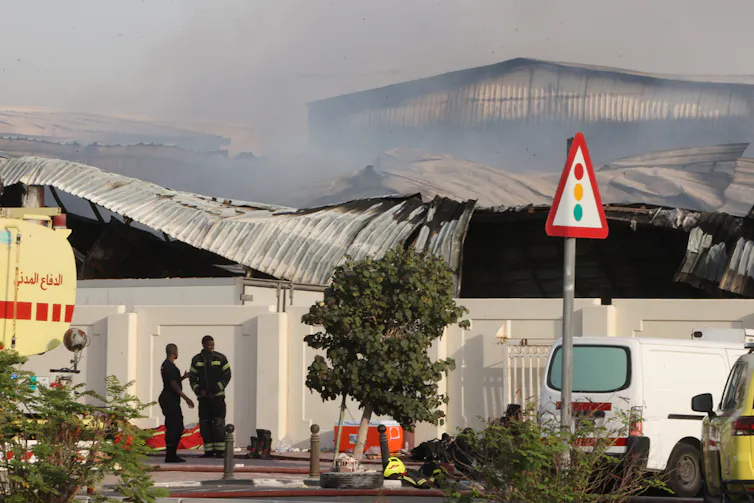
Officials statements from Gulf capitals that have consistently – and correctly – emphasized their direct noninvolvement in the U.S.-Israeli military campaign have fallen on deaf ears in Tehran.
An incident on March 2 that saw Qatar down[32] two Iranian Soviet-era fighters was a defensive measure. The jets had entered Qatari airspace with the apparent intent[33] to strike Al Udeid, the air base that houses the forward headquarters of U.S. Central Command.
However, the scope of Iran’s attacks has gone far beyond military facilities used by U.S. forces and have hit the sectors – travel, tourism and sporting events – that put the region so firmly on the global map.
Nowhere is this more the case than the energy sector that has underwritten and made possible the transformation of the Gulf states over the past half-century, and whose health remains vital to the global economy and supply chains in oil, gas and many derivative products.
If that sector remains firmly in the crosshairs, there’s no telling how intense the regional and global consequences of the ongoing war in Iran may prove to be.
References
- ^ tit-for-tat strikes (www.bbc.com)
- ^ targeted facilities (www.argusmedia.com)
- ^ vowed to retaliate (www.theguardian.com)
- ^ missiles caused (www.aljazeera.com)
- ^ said additional attacks on March 19 (www.qatarenergy.qa)
- ^ suspected Iranian aerial attacks also caused damage (www.reuters.com)
- ^ scholar of the Gulf (www.bakerinstitute.org)
- ^ AP Photo / Vahid Salemi, File (newsroom.ap.org)
- ^ gas is not connected (www.usgs.gov)
- ^ discovered in 1971 (energy-analytics-institute.org)
- ^ Israel struck oil storage facilities (www.aljazeera.com)
- ^ targeted the Shaybah (www.longwarjournal.org)
- ^ Shah gas field (www.cnbc.com)
- ^ facilities (www.cnbc.com)
- ^ grown into an important (www.wired.me)
- ^ repeated targeting (oilprice.com)
- ^ East-West pipeline (www.middleeasteye.net)
- ^ drone had struck (oilprice.com)
- ^ a ballistic missile that targeted (saudigazette.com.sa)
- ^ Houthi Media Center/Getty Images (www.gettyimages.com)
- ^ led a campaign against shipping in the Red Sea (www.washingtoninstitute.org)
- ^ other energy infrastructure (en.majalla.com)
- ^ giant LNG “trains (finance.yahoo.com)
- ^ was damaged (www.wsj.com)
- ^ second attack damaged (www.reuters.com)
- ^ forcefully condemned (www.timesofisrael.com)
- ^ they tried to avert (amwaj.media)
- ^ ceasefire that ended the 12-day war (www.politico.com)
- ^ feared that the next round (www.aljazeera.com)
- ^ that sees itself in an existential (www.atlanticcouncil.org)
- ^ AP Photo (newsroom.ap.org)
- ^ Qatar down (www.aljazeera.com)
- ^ with the apparent intent (www.ynetnews.com)
Authors: Kristian Coates Ulrichsen, Fellow for the Middle East at the Baker Institute, Rice University