

The nation is missing millions of voters due to lack of rights for former felons
- Written by Kevin B. Smith, Professor of Political Science, University of Nebraska-Lincoln
If you gathered every American with a prison record into one contiguous territory and admitted it to the union, you would create the 12th-largest state. It would be home to at least 7 million to 8 million people[1] and hold a dozen votes in the Electoral College[2].
In a close presidential race, this hypothetical state of the formerly incarcerated could decide who wins the White House.
It may sound far-fetched to conceive of former felons determining the outcome of a presidential election, not by voting but by failing to vote. But there’s a real chance they already have – not just once, but twice. That’s in addition to affecting the outcomes of some U.S. Senate and gubernatorial elections.
I am a political scientist[3] with a long-standing interest in the question of why mass incarceration rates vary so widely across states[4]. My 2024 book, “The Jailer’s Reckoning[5],” explores that question and measures its political, social and economic impacts.
One of my findings is that the sheer number of people who’ve cycled through prisons over the past 40 years is influencing election outcomes.
Scholars vigorously debate[6] the reasons why the United States locks up more of its citizens[7] than any other liberal democracy, or even most authoritarian regimes. Less examined are the consequences of this decades-long social experiment in mass incarceration.
The consequences, however, likely include affecting the results of close elections. Incarceration certainly plays a key role in depressing voter turnout, which lags, in no small part, because felony convictions have made so many people ineligible[8].
Mass incarceration has led to a fast-growing bloc of citizens who either are legally barred from voting or have just stopped bothering. Under the right circumstances, this slice of the electorate is large enough to tip an election.
Imprisonment and the franchise
Felony conviction reduces political engagement[9], sometimes entirely. Inmates are legally barred from voting in all but two states, Maine and Vermont[10]. Ten states bar ex-felons from voting[11] either permanently or for some period of time, depending on the crime, absent unusual circumstances such as a governor’s pardon.
In Idaho, Oklahoma and Texas, a criminal record means that as many as 1 in 10 citizens are ineligible to vote[12]. Among Black Americans, that number can jump to 1 in 5.
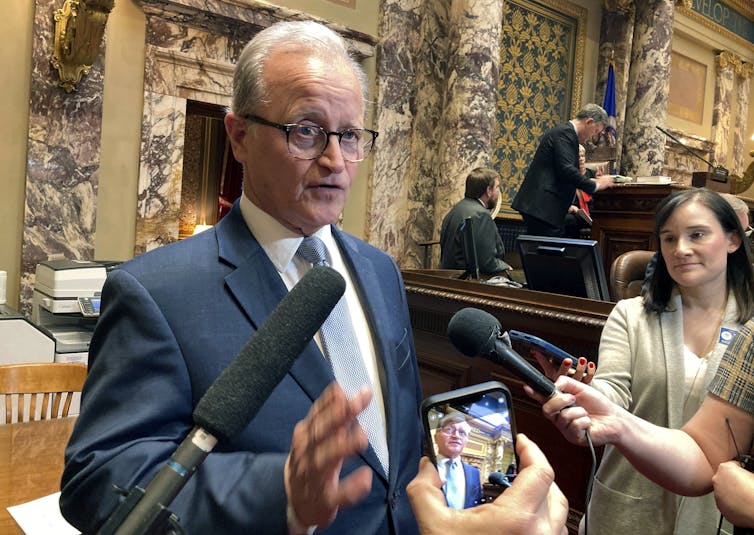
However, even when legally eligible, ex-convicts rarely exercise the right to vote. Turnout rates among this population may be as low as 10%[14]. Contact with the criminal justice system lowers political trust, which in turn reduces the likelihood of political engagement[15] among ex-convicts.
Although scholars debate the exact partisan tilt of this potential constituency[16], there’s a consensus that it is disproportionately Democratic. The upper end of estimates suggest that if this group showed up to the polls, 70% would cast ballots for Democrats[17].
Even estimates that are much lower sketch a picture of an alternative political world. In 2000, roughly 7%[18] of Florida’s 11.7 million voting-age residents[19] were disenfranchised due to past convictions. They represented about 800,000 potential voters.
If 10% of them had voted and, say, 55% voted Democratic for president, that would have translated to a 6,000-vote swing for Vice President Al Gore. In reality, Texas Gov. George W. Bush won the state – and with it the presidency – by 537 votes[20].
Florida Republicans Ron DeSantis[21] and Rick Scott[22] may have owed their initial, tight gubernatorial victories to felony disenfranchisement, since the outcomes could have been much different if former felons had the franchise.
In 2018, Florida voters did approve a constitutional amendment to restore voting rights automatically[23] to most former felons. But a subsequent law requiring felons to pay off fines and fees[24] has kept nearly 1 million Floridians from being able to vote, according to the Sentencing Project[25], a group that opposes mass incarceration.
An electorate in the shadows
Serving time behind bars or having a felony record is not a social anomaly. It is an increasingly normalized feature of American life.
The most careful scholarly estimate suggests that at least 20 million Americans[26] have served time in prison or lived under felony supervision, or both. That’s now a conservative estimate, as it is based on 2010 data.
Given their lack of voting habits, the millions of people in this group constitute a vast shadow electorate, far larger than the roughly 2% of American citizens legally ineligible to vote[27] due to being currently incarcerated.
These disenfranchised or absent voters are a quiet force with the potential to reshape American democracy. The statistical models in my book show that in statewide races this constituency represents roughly a 1- or 2-percentage-point swing.
That might not sound like much, and in single-party strongholds it is not. In genuinely competitive statewide elections, however, a percentage point or two can be decisive.
Consider the 2016 presidential election. That year, the Electoral College outcome was decided by Michigan, Pennsylvania and Wisconsin. Donald Trump won all three states by less than a percentage point[28]. Again, the outcome could easily have been different if voting rights for former felons were a given.
References
- ^ at least 7 million to 8 million people (doi.org)
- ^ Electoral College (www.archives.gov)
- ^ political scientist (scholar.google.com)
- ^ vary so widely across states (doi.org)
- ^ The Jailer’s Reckoning (www.bloomsbury.com)
- ^ vigorously debate (doi.org)
- ^ United States locks up more of its citizens (worldpopulationreview.com)
- ^ felony convictions have made so many people ineligible (doi.org)
- ^ reduces political engagement (doi.org)
- ^ Maine and Vermont (www.sentencingproject.org)
- ^ Ten states bar ex-felons from voting (www.sentencingproject.org)
- ^ as many as 1 in 10 citizens are ineligible to vote (www.sentencingproject.org)
- ^ AP Photo/Steve Karnowski (newsroom.ap.org)
- ^ may be as low as 10% (doi.org)
- ^ reduces the likelihood of political engagement (doi.org)
- ^ scholars debate the exact partisan tilt of this potential constituency (doi.org)
- ^ 70% would cast ballots for Democrats (doi.org)
- ^ roughly 7% (www.prisonpolicy.org)
- ^ 11.7 million voting-age residents (www.eac.gov)
- ^ 537 votes (constitutioncenter.org)
- ^ Ron DeSantis (www.npr.org)
- ^ Rick Scott (ballotpedia.org)
- ^ constitutional amendment to restore voting rights automatically (ballotpedia.org)
- ^ requiring felons to pay off fines and fees (floridaphoenix.com)
- ^ according to the Sentencing Project (www.sentencingproject.org)
- ^ at least 20 million Americans (doi.org)
- ^ 2% of American citizens legally ineligible to vote (www.sentencingproject.org)
- ^ all three states by less than a percentage point (uselectionatlas.org)
Authors: Kevin B. Smith, Professor of Political Science, University of Nebraska-Lincoln