

Russia’s drone pipeline: How Iran helps Moscow produce an ever-evolving unmanned fleet
- Written by Amy McAuliffe, Visiting Distinguished Professor of the Practice, University of Notre Dame
With Russian ground troops bogged down in a grinding war of attrition[1], Moscow is striving to press home its advantage in the skies – through an ever-evolving army of drones, courtesy of Iran.
In early January, wreckage of a drone found in Ukraine[2] hinted at a new high-speed model of drone being deployed by Russia in the conflict. It prompted Ukraine President Volodymyr Zelenskyy to air fears over failing to keep pace[3]. “We produce (drones) at about 1,000 a day. We really produce them, but it’s not enough. It’s still not enough,” he told an audience of political business leaders at the World Economic Forum[4] on Jan. 22, 2026.
Ukrainian intelligence suggests that Moscow, too, will also soon be pumping out 1,000 drone units a day[5], in large part thanks to the support and technical assistance of Iran. A central concern for Ukraine is Russia’s increasing production of long-range attack drones that it has used in mass attacks to strike targets in Ukraine.
Tehran’s role in supplying Russia with hundreds of long-range, kamikaze-style drones is long known. But what has gone largely unnoticed outside Ukraine is Iran’s central role in teaching Russia to produce these drones itself.
As an expert on weapons technology and former assistant director of the CIA for weapons and counterproliferation[6], I believe use of Iranian technology has helped Russia develop a fleet of sophisticated drones able to erode Ukrainian air defenses and strain the country’s resolve. By doing so, Moscow is able to preserve more expensive missiles for long-range precision strikes.
Designed in Iran, produced in Russia
Both Ukraine and Russia have ramped up drone production since the beginning of the current conflict in February 2022.
Russia was initially unable to produce large numbers of kamikaze drones, and the country’s military seemingly did not at first understand[7] the decisive role long-range strike drones could play. Instead, Moscow invested in traditional battlefield weapons, such as missiles. It mainly thought of drones as carrying out the roles of intelligence, reconnaissance and surveillance.
Tehran had the expertise Russia needed. It also had an existing defense relationship with Russia. Moreover, faced with a cash-strapped economy due to yearslong sanctions[8], Iran needed money.
Since probably about early 2022, Tehran has been providing drones and drone technology[9] to Russia for use in Ukraine. Later that year, Russia and Iran signed the agreement to set up a production plant in Russia for Iranian-designed attack drones.
With Iranian blueprints and technology, a production plant in Tatarstan[10] in western Russia now produces large numbers of drones originally designed by Iran. At this factory, Russia manufactures the Geran-2, Moscow’s name for the Iranian Shahed-136 strike drone.
Easily identifiable by its delta-wing shape, the drone has optimized certain design features[11], such as range, endurance and weight capacity. It can carry an estimated 90 to 110 pounds of explosives hundreds of miles.
Meanwhile, the delta-wing design optimizes precision diving, helps prevent stalling at low speeds, and increases the drone’s stability during the attack phase.
These features enable targeting of strategic infrastructure at much less cost than long-range missiles.

Russia can now produce hundreds of one-way Geran-2 attack drones a day. It may soon be able to launch thousands in salvos.
Russia is also modifying and enhancing the drones with features such as precise navigation, heavier warheads and new engines.
Some reports claim Russia is testing telemetry and video links[14] to fly drones remotely, a significant improvement over its current preprogrammed design that would improve accuracy and range. Iran also supplied Russia with technology to build a jet-powered drone variant based on the Shahed-238 that can fly faster.
Called the Geran-3, Russia has produced and used fewer of these drones, whose jet power[15] makes them more challenging for Ukrainian air defense to detect and intercept. New generations of the drone – Geran-4s and Geran-5s[16] – have since been rolled out and apparently deployed in the war with Ukraine[17].
Sanctions-busting procurement
Even with the blueprints and Iranian assistance, Russia is still reliant on Western and Chinese suppliers for some drone components[18], many of them commercial, off-the-shelf technology. These include the engine, fuel pump, GPS and navigation systems, semiconductors and components for antennas.
To assist Russia, Iran exploits its networks of brokers and companies in acquiring Western components to evade international sanctions.
A procurement network headed by the Iranian company Sahara Thunder used shipping firms in the UAE and India to sell Russia the original Iranian drones and components and to negotiate the deal for the production plant[19].
The U.S. Treasury Department has sanctioned this firm and others involved in the drone sales, but Iran set up new companies to help Moscow acquire components. Multiple studies and reports documenting the inclusion of foreign components in downed Geran-2s show Moscow’s continued acquisition of these parts, almost certainly with Iranian assistance[20].
A weapon of terror
Russia uses the Geran and other longer-range Iranian and Russian models to purposefully target civilians and civilian infrastructure in Ukraine, including residential housing in Ukrainian cities. Russia has even targeted first responders and humanitarian distribution points, according to a United Nations account[21].
In fact, the U.N. concluded[22] in October 2025 that Russia’s use of short-range, unmanned aerial vehicles against civilians in southern Ukraine constituted a crime against humanity and a war crime.
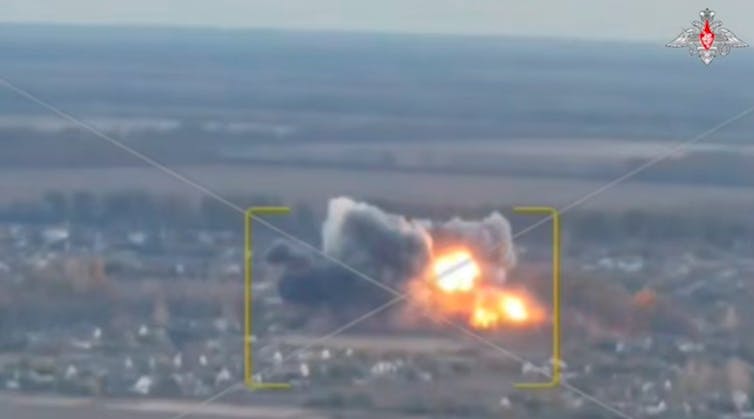
A two-day attack in May 2025 on the Ukrainian cities of Kharkiv in the northeast and Odessa in the south highlights the destructive power and human cost of the drone attacks. According to accounts in the Kyiv Post[24], Russia launched over 100 drones. In Kharkiv, three blocks were burned down, including 90 shops, and two people were injured. In Odessa, the drones killed one person and damaged residential buildings.
Beyond psychologically tormenting the Ukrainian population, these drones have a profound effect on the battlefield.
Ukraine has responded to Russia’s battlefield success with the Iranian-designed drones by diversifying the types of drones it manufactures, attacking Russian infrastructure for manufacturing drones and developing counter-drone technologies.
A mutually beneficial arrangement
Iran also benefits from this terror campaign. Reeling from the economic impact of sanctions, Iran will make an estimated US$1 billion to $1.75 billion[25] from the deal for drones and the production facility. Russia is reportedly paying Iran a portion of the bill in gold[26].
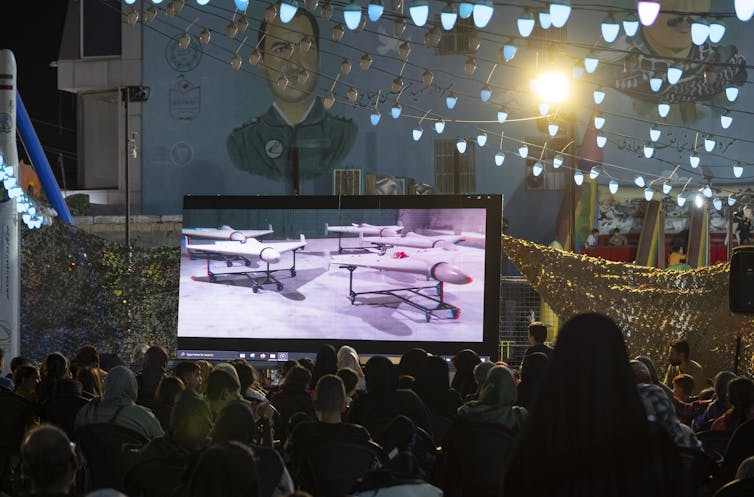
Iran is unlikely to stop its assistance anytime soon, given its own economic problems. Helping Moscow obtain drone components and even modify new versions of the Geran-2 will also benefit Iran militarily as it, too, learns to make the new drones and use them itself.
But the main beneficiary of this relationship is Moscow. Without Iranian support, Russia would face more difficult trade-offs on the battlefield. The lower-cost drones allow Russia to preserve its expensive advanced missiles for the most significant targets in Ukraine and to employ large swarms of drones to target Ukrainian infrastructure.
And with the ground offensive yielding little progress of late for Moscow, that could be crucial as the war enters its fifth year.
References
- ^ bogged down in a grinding war of attrition (www.economist.com)
- ^ wreckage of a drone found in Ukraine (www.theguardian.com)
- ^ air fears over failing to keep pace (www.businessinsider.com)
- ^ at the World Economic Forum (www.weforum.org)
- ^ pumping out 1,000 drone units a day (www.businessinsider.com)
- ^ expert on weapons technology and former assistant director of the CIA for weapons and counterproliferation (keough.nd.edu)
- ^ did not at first understand (www.atlanticcouncil.org)
- ^ cash-strapped economy due to yearslong sanctions (www.aljazeera.com)
- ^ has been providing drones and drone technology (www.cnbc.com)
- ^ production plant in Tatarstan (www.cnn.com)
- ^ design features (www.scirp.org)
- ^ National Police of Ukraine/Wikimedia Commons (commons.wikimedia.org)
- ^ CC BY-SA (creativecommons.org)
- ^ testing telemetry and video links (united24media.com)
- ^ jet power (defence-blog.com)
- ^ Geran-4s and Geran-5s (isis-online.org)
- ^ deployed in the war with Ukraine (www.theguardian.com)
- ^ for some drone components (thediplomat.com)
- ^ negotiate the deal for the production plant (www.iranwatch.org)
- ^ certainly with Iranian assistance (www.cna.org)
- ^ according to a United Nations account (www.ohchr.org)
- ^ U.N. concluded (www.ohchr.org)
- ^ The Russian Ministry of Defense/Anadolu via Getty Images (www.gettyimages.com)
- ^ Kyiv Post (www.kyivpost.com)
- ^ an estimated US$1 billion to $1.75 billion (www.yahoo.com)
- ^ portion of the bill in gold (c4ads.org)
- ^ Morteza Nikoubazl/NurPhoto via Getty Images (www.gettyimages.com)
Authors: Amy McAuliffe, Visiting Distinguished Professor of the Practice, University of Notre Dame