

Venezuela’s civil-military alliance is being stretched — if it breaks, numerous armed groups may be drawn into messy split
- Written by Rebecca Hanson, Associate Professor of Latin American Studies, Sociology and Criminology, University of Florida
The immediate political void left in Venezuela by Nicolás Maduro’s abrupt removal from power[1] has been filled by the former vice president, Delcy Rodríguez, who was sworn in as interim president[2] on Jan. 5, 2026.
But the situation is far from stable. Rodríguez represents just one of multiple and competing interests within a Venezuela elite composed of a precarious civil-military alliance[3] officially committed to a leftist populist ideology called Chavismo[4].
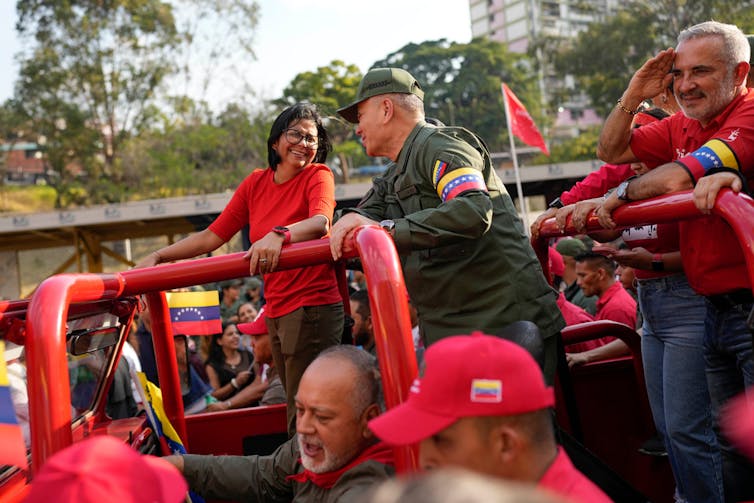
Delcy and her brother Jorge Rodríguez, the longtime right-hand man of Maduro, are the leading faces of the civilian factions. Interior Minister Diosdado Cabello and Defense Minister Vladimir Padrino López, both members of the armed forces, represent its military interests.
Even this rough civilian-military split represents just the institutional dimensions of power in Venezuela. There are also numerous armed groups and organizations[5] with distinct interests that will respond differently to what happens in the coming days and weeks.
As scholars who have spent[6] decades researching these armed groups[7], we know that Chavista leadership now faces a stark dilemma: Does it acquiesce to U.S. pressure and coercion[8] over domestic economic and policy decisions or does it resist? Both paths risk armed conflict of varying severity, with wide-ranging consequences for the country’s future stability.
Below, we identify the main armed actors and examine how they may respond to choices made by Chavismo’s leadership in response to Trump’s use of force.
A fragile unity
If current elite cohesion holds and Chavista leadership acquiesces to Trump’s designs on the country, in our opinion the likelihood of large-scale armed conflict remains low.
Over the years, the government has consolidated loyalty by installing officers[9] at the helm of state institutions and granting access to resources[10] such as oil, gold mining[11] and drugs. Future government cohesion would be contingent on the military’s continued control of key institutions, as well as the legal and illicit markets that underpin senior officers’ wealth.
But the risk of instability also lies outside of elite unity, with the armed “colectivos[12].” These diverse groups range from loyal government supporters to factions more critical of the government. Although their numbers are unknown, colectivos are numerous, coordinated, often heavily armed and control significant territory – including in the country’s capital.
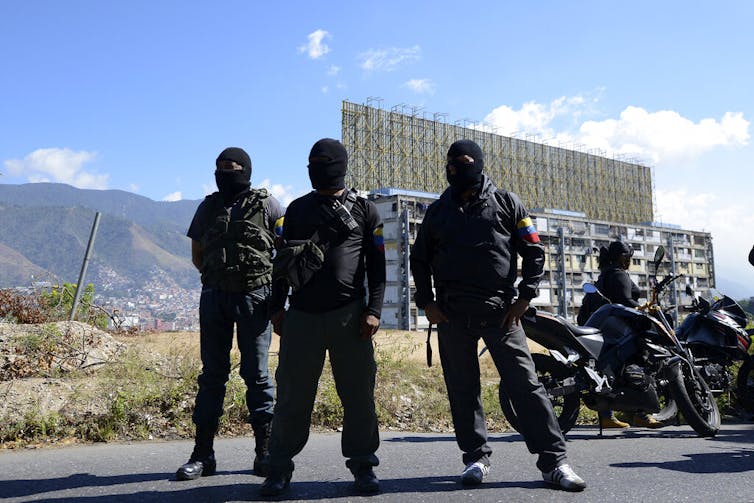
While many are now driven primarily by economic interests, a subset retains insurgent, ant-imperialist commitments[14]. Should Chavista elites be perceived as acquiescing to U.S. pressure going forward, these groups could interpret such accommodation as ideological betrayal and turn to guerrilla violence.
As a founder of one of the largest and most powerful colectivos put it when we interviewed him in 2021: “As long as imperialism exists, armed struggle will always be present because imperialism seeks to destroy the people.”
While colectivo members were largely quiet[15] immediately after Maduro’s abduction, some videos released on social media[16] and news outlets[17] have shown men believed to be colectivo members harassing reporters and people in the streets.
Potential for political rupture
It remains unclear how durable the current unified but already fraught Chavista front will prove. Indeed, the Rodríguez civilian wing and the Cabello-Padrino López military apparatus likely have different levels of tolerance for Trump’s propositions.
The Rodríguez siblings have generally adopted a pragmatic posture: In recent years, Delcy has shown a willingness to move away from state-led socialism toward market-oriented policies[18] in an effort to stabilize the Venezuelan economy. Moreover, embracing free-market policies could help the siblings attract support from business elites and segments of the broader population.
Military factions have increased their political weight since the death of Hugo Chávez[19], Maduro’s predecessor. These military forces want economic controls that allow them to benefit from crony capitalism and guarantee their interests in strategic enterprises – including oil, gold, food distribution and drug markets. Moreover, Chavismo’s anti-imperialist nationalist ideology is particularly salient within the armed forces.
Trump’s statements indicating the U.S. would be the de facto ruler of Venezuela[20] was likely perceived within Chavista circles as overtly blatant imperialism and an intentional public humiliation. While the Rodríguez siblings may be prepared to absorb this[21] to preserve stability and their own survival, hard-line military figures could be far less inclined to do so.
For now, the civilian leadership is at least officially committed to Maduro. Still, Trump’s framing of the Maduro operation[22] as an overt spectacle of subjugation raises the military’s political cost of continued alignment with a civilian leadership potentially seen as acquiescing to Washington’s demands.
Whether this perceived affront translates into defection will also depend on how any potential Rodríguez realignment threatens or preserves the military’s economic interests.
The contours of resulting conflict
An open rupture over the role of the U.S. in Venezuela would likely result in asymmetrical conflict between the U.S. and Venezuelan armed forces.
The National Bolivarian Armed Forces of Venezuela[24] consists of roughly 123,000 active personnel supported by about 8,000 reservists. The Bolivarian Militia, a fifth component of the armed forces that integrates civilian volunteers into the military, adds an estimated 200,000–300,000 members to this count. Although severely weakened by a years-long economic crisis, Venezuela’s armed forces remain a formidable actor.
This conflict would also probably engage the colectivos, who have collaborated with the armed forces for years as part of what Maduro has called the Unión Cívico Militar. In short, we would see both formal armed conflict and guerrilla warfare break out.
The relationship between the government and police forces has long been characterized by mistrust[25], but high-ranking officials are aware that the continued future of their institutions are tied up with Chavismo’s survival.
Of Venezuela’s more than 140 police forces, the most powerful are the Policía Nacional Bolivariana, or PNB, the CICPC, the investigative and forensic police, and the SEBIN, the political intelligence police that have become synonymous with torture[26]. The PNB and CICPC have benefited from widespread corruption under Chavismo. Their officers are involved in rampant[27] extortion[28] and kidnapping[29], and both have played central roles in systematic state violence during the Maduro era[30]. At the same time, the CICPC is widely seen as lacking ideological loyalty to the government and at some moments has bucked state policy and directives.

Police forces are more closely aligned with the military than Delcy and Jorge Rodríguez’s civilian faction. In the case of a rupture, this alignment would likely hold.
The role of criminal and guerrilla groups
Meanwhile, numerous gangs and criminal organizations operate across Venezuela, ranging from groups of 10 to 12 men to more sophisticated “mega-gangs” with over 100 members. While the Trump administration has often mischaracterized[32] these groups, it is true that relationships between the Maduro government[33] and some groups allowed them to become more organized[34], better armed[35] and more capable of governing the territories they control[36], though others were weakened[37] or dismantled by[38] the state.
Gangs and criminal organizations have no ideological loyalty to the government; their priority is preserving control over illicit markets, including drugs, kidnapping, extortion and food distribution. In the event of a civil-military split, such groups may well remain neutral, choosing instead to focus on protecting their criminal businesses and potentially using instability to expand them.
At the same time, Delcy and Jorge Rodríguez could revive a familiar strategy: negotiating informal agreements[39] with gangs in exchange for calm in the streets and tacit support.
In the past[40], Chavista governments have barred police forces from entering[41] gang-controlled areas and tolerated gang dominance over illicit markets. While such arrangements can produce short-term territorial stability, they also deepen tensions with the police.
The final major armed players in Venezuela are guerrilla political groups. The National Liberation Army, or ELN, and FARC dissident groups operate in multiple states along the Venezuela-Colombia border. Well-armed and deeply enmeshed in[42] illegal mining, extortion and smuggling, both groups have benefited from Chavismo’s rule. They have largely moved away[43] from pursuing national political power toward capturing local state infrastructure and establishing parallel authorities to control illicit markets. Nevertheless, insurgent ideologies and opposition to demobilization efforts in Colombia remain central to understanding their motivations.
Guerrilla organizations such as the ELN and FARC dissidents would also likely seek to preserve – and potentially expand – their control over illicit economies in any future political arrangement. Unlike local gangs, however, these groups maintain articulated political agendas, even if those agendas remain largely oriented toward Colombia. Any future alignment of these groups would reflect both ideological commitments and a strategic calculation that civilian factions aligned with Washington would pose a greater threat to their political and economic interests.
Addressing this constellation of armed groups through state-building and multilateral cooperation could go some way toward providing Venezuelans with stability in the post-Maduro era. But that is far from guaranteed in this uncertain moment, especially if the Trump administration continues its policy of direct coercion over Venezuelan affairs.
References
- ^ abrupt removal from power (theconversation.com)
- ^ was sworn in as interim president (www.reuters.com)
- ^ civil-military alliance (www.reuters.com)
- ^ called Chavismo (www.miamiherald.com)
- ^ numerous armed groups and organizations (www.drclas.harvard.edu)
- ^ scholars who have spent (scholar.google.com)
- ^ researching these armed groups (scholar.google.com)
- ^ U.S. pressure and coercion (www.politico.com)
- ^ consolidated loyalty by installing officers (www.occrp.org)
- ^ granting access to resources (www.nuso.org)
- ^ oil, gold mining (www.cidob.org)
- ^ colectivos (invisibles.info)
- ^ AP Photo/Matias Delacroix (newsroom.ap.org)
- ^ retains insurgent, ant-imperialist commitments (www.taylorfrancis.com)
- ^ largely quiet (www.nytimes.com)
- ^ some videos released on social media (x.com)
- ^ news outlets (www.ntn24.com)
- ^ state-led socialism toward market-oriented policies (www.nytimes.com)
- ^ death of Hugo Chávez (www.theguardian.com)
- ^ de facto ruler of Venezuela (www.bbc.com)
- ^ may be prepared to absorb this (www.theguardian.com)
- ^ Trump’s framing of the Maduro operation (www.reuters.com)
- ^ AP Photo/Matias Delacroix (newsroom.ap.org)
- ^ National Bolivarian Armed Forces of Venezuela (warontherocks.com)
- ^ has long been characterized by mistrust (global.oup.com)
- ^ have become synonymous with torture (www.hrw.org)
- ^ rampant (www.ntn24.com)
- ^ extortion (www.diariolasamericas.com)
- ^ kidnapping (www.dw.com)
- ^ played central roles in systematic state violence during the Maduro era (d1wqtxts1xzle7.cloudfront.net)
- ^ AP Photo/Matias Delacroix (newsroom.ap.org)
- ^ has often mischaracterized (theconversation.com)
- ^ relationships between the Maduro government (global.oup.com)
- ^ more organized (www.rebeccahansonsoc.com)
- ^ better armed (www.rebeccahansonsoc.com)
- ^ more capable of governing the territories they control (www.taylorfrancis.com)
- ^ were weakened (www.aljazeera.com)
- ^ or dismantled by (www.bbc.com)
- ^ negotiating informal agreements (www.rebeccahansonsoc.com)
- ^ In the past (www.rebeccahansonsoc.com)
- ^ have barred police forces from entering (www.taylorfrancis.com)
- ^ deeply enmeshed in (cup.columbia.edu)
- ^ largely moved away (cup.columbia.edu)
Authors: Rebecca Hanson, Associate Professor of Latin American Studies, Sociology and Criminology, University of Florida