

What a Cargo Net's Rated Strength Actually Tells You
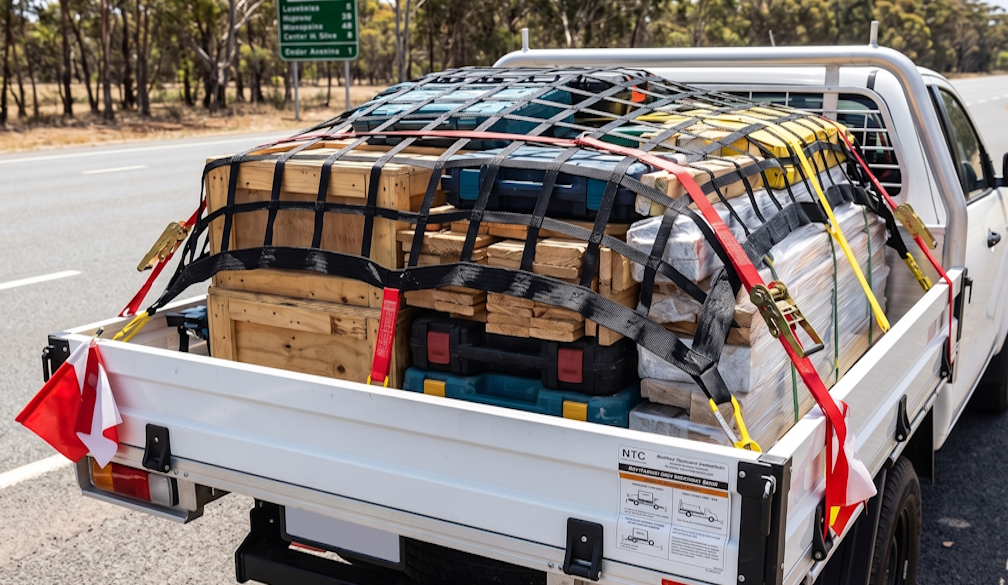
A cargo net rated to a specific breaking strength doesn't, by itself, tell anyone whether that net is legally adequate for what's loaded underneath it. The load restraint standard that applies on Australian roads isn't a fixed number printed on a product tag, it's a calculation based on the weight of the specific load being carried that day.
What the Load Restraint Standard Actually Requires
Under the National Transport Commission's Load Restraint Guide, a restraint system has to be capable of withstanding forces equivalent to a set proportion of the load's own weight, applied in different directions to reflect what actually happens on the road: roughly 0.8 times the load's weight forward to account for hard braking, 0.5 times rearward, 0.5 times sideways for cornering, and 0.2 times upward for rough surfaces. In practical terms, a heavier load generates proportionally larger forces in an emergency stop or sharp corner, and the restraint holding it down has to be strong enough to counter those forces specifically, not just strong enough in some general sense.
Why a Net's Rating Is a Starting Point, Not an Answer
This is where a webbing strength figure and legal compliance can pull apart. A net rated at a certain breaking strength per inch of webbing is describing a fixed property of that net, tested independently of what it will actually be asked to hold. Whether that rating clears the bar set by the load restraint standard depends entirely on the weight of the load sitting under it that day. The same net comfortably restraining a load of garden tools might fall short of what's required for a load of building materials weighing several times as much, even though nothing about the net itself has changed between the two jobs. Checking a heavy duty cargo net against the actual weight being carried, rather than assuming a higher-rated product automatically covers every load that might go under it, is the practical starting point for getting this right.
Why Attachment Points and Tensioning Matter Just as Much
A net's rated capacity only holds up in practice if the rest of the system supports it. Anchor points need to be rated for the pull they'll actually experience under those same g-force multipliers, since a net attached to a weak or poorly positioned tie-down point can fail at the anchor long before the webbing itself is tested. The net also needs to sit tight enough across the load that there's no meaningful slack for cargo to shift before the net actually engages. A loosely stretched net over an irregularly shaped load can leave gaps where a smaller item works its way free well before the net's rated strength becomes relevant at all.
What's Worth Checking Before Loading Up
A few checks are worth running through before relying on a net for a specific job: confirming the actual weight of the load rather than estimating it, checking the net's rated capacity against that weight under the standard's force multipliers rather than assuming "heavy duty" covers it automatically, confirming the anchor points being used are rated to match, and checking the net is tensioned firmly across the whole load rather than loosely draped over it. Each of these addresses a different way a technically adequate net can still end up restraining a load inadequately in practice. It's also worth accounting for how a load might shift or settle over the course of a trip, since a net tensioned correctly at the start of a long drive can loosen slightly as items bounce and resettle, which is one reason a mid-trip check on longer journeys is a reasonable habit rather than an unnecessary precaution.
The Net Is Part of a System, Not the Whole Answer
None of this means cargo nets are an unreliable way to secure a load, for a huge range of everyday jobs they're a straightforward, effective option. The point is that a net's rating describes one component of a system that also depends on anchor point strength, tensioning and an honest assessment of what's actually being carried. Treating the rating on the packaging as the entire compliance question, rather than one input into it, is generally where the gap between a technically rated product and an actually secure load tends to open up.