

More Than a Swim: The Conservation Science Behind Every Three Islands Whale Shark Tour
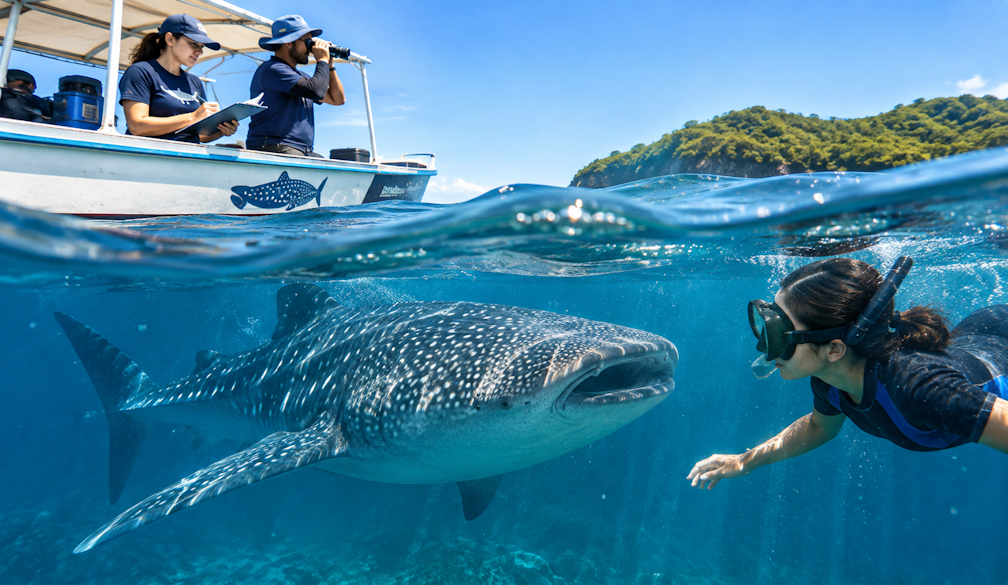
When people compare whale shark tour prices in Exmouth, the number that stops them is usually A$620. It sits well above what a standard reef snorkel costs, and for anyone booking without context, the gap can feel hard to justify. But that price point tells only part of the story, and the more important part has nothing to do with what happens on the boat.
Every Three Islands Whale Shark Tour is built around a formal partnership with ECOCEAN, Australia's only not-for-profit research organisation dedicated to conserving whale sharks. The company holds Advanced ECO Certification through Ecotourism Australia and operates as a carbon-neutral business. These are not marketing labels. They represent a structure in which a portion of every fare, the use of the vessel Draw Card, and fuel for ECOCEAN's local research activities are all directed toward a species that the IUCN Red List currently classifies as Endangered, just two steps from extinction in the wild.
The real question is not whether A$620 is a lot for a swim. It is whether it is a reasonable contribution to keeping the world's largest fish in the ocean.
The answer, when you understand what that money funds, is unambiguous.
A Species on the Edge: Why the Research Matters Now
The whale shark (Rhincodon typus) is the largest fish on Earth, and it is disappearing. The 2025 IUCN Red List assessment, co-authored by ECOCEAN founder Dr Brad Norman, confirmed the species' Endangered status, reflecting decades of population decline driven by targeted hunting in parts of Asia, fisheries bycatch, ship strikes, plastic ingestion, and the compounding pressures of climate-driven changes to ocean productivity.
What makes the situation particularly difficult for scientists is how little is still known about the species' most critical life stages. Despite more than 30 years of research, no one has ever observed a whale shark mating or giving birth in the wild. The location of breeding grounds remains unknown. Without understanding where and how the population reproduces, conservation planning has significant blind spots.
The Scale of the Ningaloo Population
Ningaloo Reef is one of the most scientifically important whale shark aggregation sites in the world. Research from the CSIRO Ningaloo Outlook program has produced some of the most significant findings in whale shark science to date:
- Approximately 500 individual whale sharks visit Ningaloo annually
- DNA analysis has confirmed that Ningaloo sharks share parents with aggregations in Madagascar and Tanzania, more than 8,000 km away
- Preliminary estimates suggest a single adult breeding population of around 5,000 individuals exists across the Indian Ocean, the first estimate of its kind for any whale shark population
- Individual sharks tracked by satellite have been recorded travelling as far south as Perth before returning to Ningaloo
Key insight: The Ningaloo population is not isolated. It is genetically connected to whale sharks across the Indian Ocean, which means protecting it here has consequences for the species globally.
This is the scientific context in which Three Islands operates. The tours do not exist alongside the research; they are structurally embedded within it.
The ECOCEAN Partnership: What It Actually Funds
Three Islands has maintained a formal research partnership with ECOCEAN since the organisation's earliest years at Ningaloo. This is a meaningful distinction from operators who simply describe themselves as conservation-minded. The partnership involves concrete, operational contributions:
|
Contribution |
What It Enables |
|
Use of the Draw Card vessel |
ECOCEAN researchers conduct field work, tagging operations, and data collection from the boat |
|
Fuel provision |
Supports ECOCEAN's local research activities and spotter plane operations |
|
Dedicated spotter plane time |
Aerial surveys used for population monitoring and whale shark location during tours |
|
Citizen science photo data |
Guest photographs submitted to the Sharkbook: Wildbook for Whale Sharks database for individual identification |
Thirty Years of Photo-ID: Building the World's Longest Running Shark Study
ECOCEAN founder Dr Brad Norman pioneered the use of whale sharks' unique spot patterns for individual identification in the mid-1990s, right here at Ningaloo. That work grew into what is now the Sharkbook: Wildbook for Whale Sharks database, which holds records of more than 8,000 individually identified whale sharks from over 50 countries.
At Ningaloo specifically, more than 2,500 individual sharks have been identified over the course of the study, with some animals returning to the reef across multiple years. This long-term record is only possible because tourism operators and their guests have consistently contributed photographs to the library. Every image taken during a Three Islands tour that captures the distinctive spot pattern behind a shark's gills can be submitted to add to that record.
This is citizen science with direct conservation outcomes. The data feeds into IUCN assessments, informs government management decisions for Ningaloo Marine Park, and contributes to international protection frameworks under CITES and the Convention on Migratory Species.
Satellite Tagging and the Search for Breeding Grounds
One of the most pressing unknowns in whale shark science is the location of breeding habitat. ECOCEAN researchers have deployed satellite tags on large, mature sharks at Ningaloo in an effort to track their movements beyond the reef. The Three Islands vessel and spotter plane play a direct role in locating suitable tagging candidates during the season.
The tracking data has already revealed that Ningaloo sharks undertake long-distance migrations, with some individuals tracked for nearly a year before returning. This information is critical for identifying which ocean zones need expanded protection, particularly in international waters where whale sharks remain vulnerable to hunting and bycatch.
Gold Standard Tourism: How Ningaloo Earned the Title
Not all whale shark tourism is equal. In destinations across Southeast Asia and the Americas, encounters are largely unregulated: boats crowd around animals, swimmers touch or ride the sharks, and no data is collected. The ecological damage in some of these locations has been well documented.
Ningaloo operates under a fundamentally different model. The Western Australian Government has regulated whale shark tourism since 1993, making it one of the longest-running wildlife tourism management frameworks in the world. A 2025 peer-reviewed study published in the Journal of Sustainable Tourism formally assessed the impacts of Ningaloo's approach using high-resolution biotelemetry data, and its conclusion was unambiguous: Ningaloo Reef is considered the "gold standard" of whale shark tourism management worldwide, characterised by legal regulation, strict enforcement, and high compliance.
What the Rules Actually Require
The regulations governing how operators and swimmers interact with whale sharks at Ningaloo are specific and enforced:
- Vessel limits: A restricted number of licensed operators are permitted to operate during the season
- Swimmer limits: Strict limits on the number of swimmers in the water with any individual shark at one time
- Proximity rules: Minimum approach distances for both vessels and swimmers
- No-touch policy: Swimmers are prohibited from touching whale sharks
- Time limits: Maximum encounter durations per shark per day
Three Islands operates in full compliance with all of these requirements. The spotter plane is central to this compliance, allowing the crew to locate sharks before deploying swimmers and to manage encounters in a way that minimises repeated disturbance to individual animals.
What the Science Found
The biotelemetry study measured whale shark behaviour at 20 Hz using high-resolution data loggers, comparing days with tourism activity against days without. Key findings:
"Tourism-induced impacts we found on the endangered whale sharks at this highly regulated tourism site would not have been apparent from purely observational studies." (Reynolds et al., Journal of Sustainable Tourism, 2025)
The research confirmed that tourist interactions at Ningaloo had minimal short-term effects on whale sharks, with any additional energetic costs representing only around 4% of a shark's daily energy budget. Critically, there was no evidence that tourism encounters affected the likelihood of sharks returning to Ningaloo in subsequent years.
This matters for the premium pricing argument. The research backing Ningaloo's approach is not just promotional language. It is peer-reviewed science confirming that the careful, regulated model used here does not compromise the animals it depends on.
Advanced ECO Certification and Carbon-Neutral Operations
Three Islands holds Advanced ECO Certification from Ecotourism Australia, the highest tier of the national eco-certification programme. This accreditation is independently audited and requires operators to demonstrate genuine environmental management practices, not simply a commitment to them.
The certification covers several areas directly relevant to conservation outcomes:
- Environmental impact management: Documented procedures for minimising the ecological footprint of every tour
- Interpretation and education: Guides are trained to deliver accurate, science-based information about whale sharks and the Ningaloo ecosystem to guests
- Community contribution: Demonstrated support for local conservation and research initiatives, including the ECOCEAN partnership
- Carbon neutrality: Verified offset or reduction of operational carbon emissions
Why Certification Matters Beyond the Badge
Advanced ECO Certification is worth more than its logo on a website. It is the mechanism through which conservation claims are verified by an independent third party. An operator can say they care about the reef; an Advanced ECO Certified operator has had that claim assessed against a national standard.
For guests comparing operators, this distinction is significant. It means the conservation narrative attached to a Three Islands booking is not self-reported. It has been audited.
The Ecotourism Australia framework also requires ongoing compliance, meaning the certification is not a one-time achievement. It reflects the operator's current practices, not a historical credential.
The combination of Advanced ECO Certification, carbon-neutral status, and a formal research partnership with ECOCEAN places Three Islands in a genuinely small category of eco-tourism operators globally. Most operators who use conservation language in their marketing do not operate under this level of independent scrutiny.
What Guests Contribute Simply by Showing Up
One of the less obvious aspects of the Three Islands tour model is that guests are not passive participants in the conservation work. The encounter itself generates scientific value.
Citizen Science in the Water
Every photograph taken during a whale shark encounter that shows the distinctive spot pattern behind the shark's gills can be submitted to the Sharkbook: Wildbook for Whale Sharks database. The system uses pattern-recognition algorithms, originally adapted from star-mapping software used in astrophysics, to match individual sharks across submissions from around the world.
When a guest's photograph matches a record already in the library, it extends the known sighting history of that individual shark. When it does not match, it adds a new individual to the global count. Over time, this data reveals:
- Population size trends: Whether the number of individuals visiting Ningaloo is stable, growing, or declining
- Residency patterns: How long individual sharks stay at the reef and how frequently they return
- Age and growth rates: Estimated from size data recorded across multiple sightings of the same individual
- Movement corridors: When combined with satellite tracking data, photo-ID records help map the routes sharks use between aggregation sites
The Ningaloo library now holds records of more than 2,500 identified individuals, making it one of the most comprehensive long-term datasets for any large marine species in Australian waters.
The Spotter Plane as a Research Tool
The spotter plane that Three Islands uses to locate whale sharks during tours serves a dual purpose. For guests, it dramatically increases the likelihood of a successful encounter. For researchers, the aerial surveys generate systematic data on shark distribution, density, and behaviour across the reef during the season.
This aerial monitoring data contributes to the management decisions made by the Western Australian Department of Biodiversity, Conservation and Attractions for Ningaloo Marine Park, helping to determine how tourism zones are managed and whether encounter limits need adjustment.
The Ningaloo whale shark eco-tourism industry supports an annual economic value of over A$25 million, according to CSIRO Ningaloo Outlook research. That economic case is only sustainable if the population remains healthy, which is precisely what the research infrastructure Three Islands supports is designed to ensure.
The Price Breakdown: Where the Premium Goes
Understanding the cost structure of a Three Islands tour reframes the pricing question entirely. The A$620 adult fare is not a markup on a commodity experience. It reflects a specific set of operational and conservation investments that most operators do not make.
|
What You're Paying For |
Why It Costs More |
|
Dedicated spotter plane |
Aerial surveys require a licensed pilot, aircraft maintenance, and fuel for every tour day |
|
ECOCEAN research partnership |
Vessel use, fuel, and crew time directed to research operations |
|
Advanced ECO Certification |
Ongoing compliance costs, independent audits, and staff training |
|
Carbon-neutral operations |
Verified offset programmes and operational adjustments |
|
Small-group experience |
Regulatory encounter limits mean smaller groups per shark, reducing revenue per tour |
|
Expert crew and interpretation |
Marine-qualified guides trained to deliver science-based interpretation throughout the tour |
The Counter-Argument: Could You Pay Less Elsewhere?
Yes. There are whale shark experiences available in other parts of the world at a fraction of this price. The relevant question is what that price difference represents.
In unregulated destinations, the lower cost reflects the absence of research infrastructure, environmental management, independent certification, and meaningful conservation contribution. The animals in those locations bear the full cost of that savings.
At Ningaloo, under the framework that Three Islands operates within, peer-reviewed science has confirmed that the tourism model does not compromise the long-term health of the population. That outcome required decades of investment in regulation, research, and operator accountability. The premium price is, in part, a reflection of that history.
Booking a Three Islands tour is not just a transaction. It is participation in a conservation model that the global scientific community has recognised as the best of its kind, and a direct contribution to the ongoing research that keeps it that way.
Book a Tour That Does More Than It Promises
Three Islands Whale Shark Dive has been operating at Ningaloo since 1997, which means the company has been contributing to whale shark research and conservation for nearly three decades. The sharks that guests swim with today are, in a real sense, better understood and better protected because of that history.
The whale shark season runs from mid-March to July each year, with late-season combined whale shark and Ningaloo Reef tours available from September to mid-October. Tours depart from Exmouth, Western Australia, on the edge of the World Heritage-listed Ningaloo Coast.
When you book, you are not just securing a wildlife encounter. You are adding to a long-term scientific record, funding active research into one of the ocean's most endangered species, and doing it through an operator that has had its conservation credentials independently verified.
The world's largest fish needs the ocean to be worth swimming in. Three Islands is one of the operators making sure it stays that way.
Book your whale shark tour with Three Islands Whale Shark Dive