

Political polarization in Pittsburgh communities is rooted in economic neglect − not extremism
- Written by Ilia Murtazashvili, Professor of Public Policy, University of Pittsburgh
When it comes to political polarization in the United States[1], the Pittsburgh region offers a useful window into what communities can do about it.
Pittsburgh is a “comeback city.” The once-prosperous steel industry may have declined, but universities, hospitals and technology are driving reinvention[2] and a new emphasis on manufacturing.
It’s also a city where people’s economic situation and political orientation often depend on where they live and how their community and neighborhood are doing. Different neighborhoods experience different levels of safety, school quality, housing stability and responsiveness from public services. In the region’s hardest-hit communities, this shows up not only in frustration with local institutions, but in shifting voting patterns[3] and growing openness to populist messages of renewal.
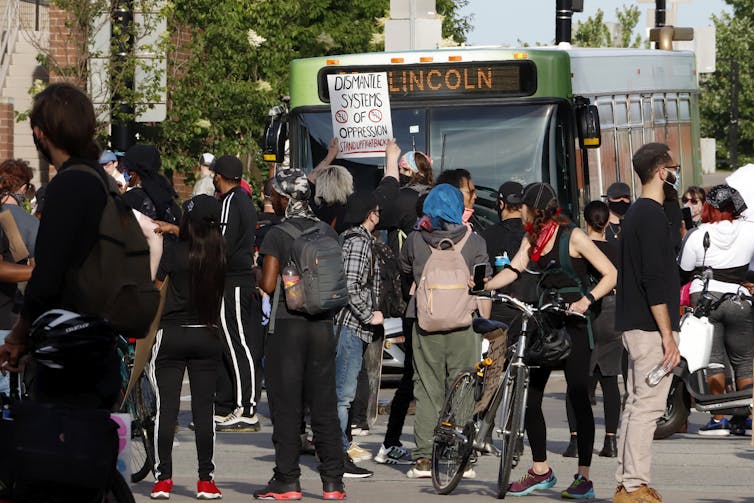
Our research at the University of Pittsburgh’s Center for Governance and Markets[5] examines Rust Belt revitalization and how economic decline reshapes civic life[6] and political conflict[7] in communities such as Pittsburgh and its surrounding mill towns.
It also shows how local government performance shapes trust and political conflict in distressed communities across the Pittsburgh region.
We’ve found that the region’s polarization is often less about culture war debates and political ideology and more about whether people think local institutions still work for them. It also grows out of economic despair, eroding trust and the feeling that the rules of the game no longer produce a future worth believing in.
This polarization plays out most visibly in practical disputes about safety[8], housing, schools and basic public services. Residents split between calls for tougher law enforcement and demands for alternative approaches to criminal justice; between building more housing[9] and regulating affordability; between consolidating schools[10] and maintaining neighborhood anchors; and between higher spending on basic services[11] such as construction costs and frustration over government’s ability to deliver.
National politics do matter here, but local conflicts are where politics become tangible and where trust rises or falls based on performance. Those decisions happen locally through city departments, school boards, neighborhood meetings and county agencies.
Not just ‘blue city, red suburbs’
At its core, Pittsburgh is really about the differences in the neighborhoods and communities. This shapes how communities perceive fairness[12] and whether they trust that the government is capable of solving problems.
In some neighborhoods, civic institutions are strong and residents feel empowered in public life. In others, decades of disinvestment have weakened the foundations of everyday governance.

Squirrel Hill is one of Pittsburgh’s most civically vibrant[14] neighborhoods. It is affluent and educated, and it has a number of synagogues, bookstores, immigrant service organizations and active civic groups. When political conflict emerged[15] in the aftermath of the Tree of Life synagogue mass shooting[16], residents had networks to absorb disagreement rather than let it spiral into hostility.
Now shift to the South Side, where gentrification shapes politics[17] differently. The South Side Flats evolved from a blue-collar neighborhood into a place with many renters and younger residents. People are civic-minded, though local debates often revolve around nightlife[18], public safety, rising costs and development.
Carrick remains politically mixed, reflecting tensions in a working- and middle-class community navigating demographic change[19] and uncertainty about the future. Local concerns include schools, traffic, infrastructure and neighborhood stability, but national polarization shapes how issues are interpreted[20]. Potholes become a service complaint and a symbol of being left behind. Housing projects become flash points for who belongs[21].
Homewood is a historically Black neighborhood shaped by decades of disinvestment. Deep challenges[22] include poverty, blight and long-standing concerns about safety. Yet it also shows civic resilience[23] through churches, nonprofits, health centers and grassroots leaders who have kept public life intact even when government capacity falls short. Even in heavily democratic neighborhoods like Homewood, citizens feel a sense of being overlooked[24].
Different neighborhoods experience “Pittsburgh” through different governing realities. The suburbs and mill towns are part of the story, too.

In Braddock[26], where U.S. Sen. John Fetterman[27] once served as mayor, the collapse of the steel economy severely damaged the tax base and weakened local capacity to provide reliable services. When municipal governments are forced to govern with fewer resources, politics become a battle over shortages of basic services, such as trash collection[28]. Civic participation declines[29], and frustration is unabating.
In Aliquippa[30], the closure of major steel employers contributed to long-term economic contraction and political realignment. Communities once firmly Democratic have become more open to conservative populism[31], including among working-class and minority voters attracted to messages of economic renewal. This shift often involves less dramatic ideological conversation than a search for a political language that takes economic loss seriously.
 Young supporters of U.S. Vice President Kamala Harris celebrate as her motorcade departs from Aliquippa High School during her 2024 presidential campaign .
Anna Moneymaker/Getty Images[32]
Young supporters of U.S. Vice President Kamala Harris celebrate as her motorcade departs from Aliquippa High School during her 2024 presidential campaign .
Anna Moneymaker/Getty Images[32]
And in McKeesport[33], a former manufacturing hub, economic distress combines with infrastructure decay[34] and opioid addiction[35]. Yet McKeesport also shows that polarization does not erase cooperation. Community organizations build partnerships around practical concerns[36], such as youth programming, small-business support and downtown development.
The Pittsburgh region is not “blue city, red suburbs.” Deindustrialization did more than eliminate jobs[37]: It reduced mobility, strained families, shrank tax bases, weakened local civic institutions and made daily life feel less stable.
A lesson from Pittsburgh’s new mayor
Corey O’Connor, Pittsburgh’s new mayor, has emphasized economic revitalization[38], but also has argued what many officials forget or ignore: Residents judge government first by whether it delivers basic competence.
For many Pittsburghers, a government that cannot clear streets[39] after a storm, fill potholes[40] or maintain a functional snow removal[41] fleet does not feel capable of managing large-scale economic revitalization or building civic trust. Snow removal and filling potholes aren’t trivial issues, but a test of whether public authority is reliable and fair.
When basic services cannot be provided in real time, mistrust becomes almost inevitable.
Rebuilding legitimacy from the bottom up
Escaping polarization requires a long-term strategy to rebuild opportunity, restore institutional credibility and strengthen civic infrastructure.
For Pittsburgh and its region, this depends on fostering frameworks for civic participation[42] by expanding job training programs and delivering public services effectively, including through municipalities helping each other out[43] to provide them.
Research shows that competence in the everyday work of government is a significant way to rebuild trust in public institutions[44]. Starting with the basics in local government demonstrates that cooperation is possible and institutions can solve problems.
The lesson of Pittsburgh is that economic stability is civic stability. When it collapses, politics become less about disagreement than respect and recognition. Polarization is a consequence of people not feeling seen, heard or treated fairly by the institutions that govern them. Communities cannot wait for Washington to solve problems that are experienced – and addressed – locally.
References
- ^ political polarization in the United States (theconversation.com)
- ^ driving reinvention (www.post-gazette.com)
- ^ shifting voting patterns (www.publicsource.org)
- ^ Gene J. Puskar/AP (newsroom.ap.org)
- ^ Center for Governance and Markets (cgm.pitt.edu)
- ^ economic decline reshapes civic life (papers.ssrn.com)
- ^ political conflict (papers.ssrn.com)
- ^ practical disputes about safety (www.publicsource.org)
- ^ housing (iamhomewood.com)
- ^ consolidating schools (www.publicsource.org)
- ^ basic services (www.publicsource.org)
- ^ shapes how communities perceive fairness (papers.ssrn.com)
- ^ SOPA Images/Contributor/Getty Images (www.gettyimages.com)
- ^ civically vibrant (news.yale.edu)
- ^ political conflict emerged (www.wesa.fm)
- ^ Tree of Life synagogue mass shooting (theconversation.com)
- ^ gentrification shapes politics (theconversation.com)
- ^ revolve around nightlife (www.pittsburghpa.gov)
- ^ demographic change (www.neighborhoodscout.com)
- ^ national polarization shapes how issues are interpreted (www.vox.com)
- ^ flash points for who belongs (www.wesa.fm)
- ^ Deep challenges (www.publicsource.org)
- ^ also shows civic resilience (engage.pittsburghpa.gov)
- ^ sense of being overlooked (www.publicsource.org)
- ^ Jeff Swensen/Getty Images (www.gettyimages.com)
- ^ Braddock (www.washingtonpost.com)
- ^ U.S. Sen. John Fetterman (theconversation.com)
- ^ such as trash collection (www.wpxi.com)
- ^ Civic participation declines (www.carnegie.org)
- ^ Aliquippa (carnegieart.org)
- ^ conservative populism (www.wesa.fm)
- ^ Anna Moneymaker/Getty Images (www.gettyimages.com)
- ^ McKeesport (beltmag.com)
- ^ infrastructure decay (www.wpxi.com)
- ^ opioid addiction (www.wesa.fm)
- ^ practical concerns (www.witf.org)
- ^ more than eliminate jobs (frontiergroup.org)
- ^ economic revitalization (www.post-gazette.com)
- ^ cannot clear streets (www.post-gazette.com)
- ^ fill potholes (www.publicsource.org)
- ^ snow removal (www.cbsnews.com)
- ^ fostering frameworks for civic participation (triblive.com)
- ^ helping each other out (triblive.com)
- ^ rebuild trust in public institutions (datasmart.hks.harvard.edu)
Authors: Ilia Murtazashvili, Professor of Public Policy, University of Pittsburgh